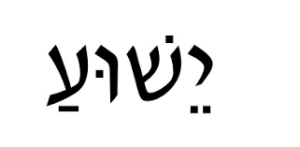
Several years ago, I acquired a book entitled Understanding the Difficult Words of Jesus. One of its two authors, Dr. David Bivin, resides in Israel and is one of the founders of the Jerusalem School of Synoptic Research, a think tank in which Jewish and Christian scholars strive for a better understanding of the Synoptic Gospels, Matthew, Mark and Luke. I had been an avid reader of Dr. Bivin’s teachings online.
In picking up the book, I learned a couple of things about Dr. Bivin I didn’t previously know. For one, he moved to Jerusalem in 1963 and actually served as a reservist in the Israeli military for 17 years. Yet, the most interesting thing I learned about him was his experience as a teenager reading the Bible. “My greatest difficulty,” he said, “was trying to understand the words of Jesus.” He would encounter passages such as these: “For if they do these things in a green tree, what shall be done in the dry?” (Luke 23:31) “From the days of John the Baptist until now the kingdom of heaven suffereth violence, and the violent take it by force.” (Matthew 11:12) As a youth, he would ask his pastor or seminary professors to interpret these passages. Here was their common response: “Just keep reading, son, the Bible will interpret itself.”
Does that answer sound familiar? I’ve encountered it in my own church experience. There are many people with autism in this world who can decipher words on a page, but lack even the remotest sense of what they mean. No matter how much they read, they don’t comprehend. Eventually, they shy away from reading altogether. Though he was not autistic, Bivin’s struggles with the words of Jesus caused him to drift from reading the Gospels: “By the time I went to Israel at the age of 24 to study at Hebrew University, I had almost stopped reading the Gospels. It wasn’t that I wasn’t reading the Bible. I was reading the Bible more than ever before, but I was unconsciously neglecting the Gospels; yet, here were the real words and teachings of Jesus.” Though he would one day take his place among the most respected of Bible scholars, the young Bivin did not find the answer, “just keep reading,” to be satisfying. No matter how much of the Scripture he read—and he read it all repeatedly—the meaning of Jesus’ words was often still unclear. He wrote: “The truth is that one can keep reading the Bible forever, and the Bible will not tell him the meaning of these difficult passages.” Despite that outlook, he kept striving to understand—for the words of God are too precious and important to simply disregard or to push away in the hope of some future understanding. If we want to be intimate with Jesus, we need to understand his words.
In 1969, Bivin joined the Narkis Street Congregation in Jerusalem whose pastor was another American scholar, Dr. Robert Lindsey. Dr. Lindsey had his own brush with the difficult words of Jesus. He was at one time attempting to translate the Greek text of Mark to Hebrew. As he did this, he noticed that the order or sentence construction (syntax) of the words in Greek—often sounding very odd in Greek itself—made perfect sense when translated in the same word sequence into Hebrew. It was almost as if someone in antiquity had placed the Greek words together from a Hebrew source. He recalled that in his own training, he had a similar experience trying to translate the classical Greek books of Homer and Plato into English. “What difficulty I had in making those ancient Greeks speak English!” he said.
One day, Lindsey was teaching a class on the Gospels when he encountered the Greek word ochloi, which when translated into English often is expressed as “crowds” or “multitudes.” This word appears in the New Testament 28 times, 25 of which are found in the Synoptic Gospels: Matthew, Mark and Luke. For instance, in Matthew 9:8, having seen Jesus heal a paralytic, the Greek text reads hoi ochloi ephobethesan—which when brought over literally into English would read—“the multitudes marveled.” The English of this verse is awkward, even tortured—you can have a multitude of people in one place, but not multitudes. In fact, multitudes renders to the word multitude in most English dictionaries. The use of ochloi—a plural in Greek—puzzled Lindsey. He mentioned this in a lecture. A young, Israeli woman in his classroom piped up that ochloi sounded to her very much like the Hebrew word, ochlosim, itself a plural, but also a Hebrew idiom used by the ancient rabbis of Jesus’ day to depict “the people of a locality.” Could it be that the Greek of Matthew borrowed an idiomatic Hebrew term? Lindsey thought yes.
Both Lindsey and his disciple, Bivin, were students of the Hebrew language, and as they read the Greek words of the Gospels, they began to detect a Hebrew “voice”—a Hebrew “undertext”—speaking to them. To these scholars, translating the Greek Gospels into Hebrew clarified many of the “difficult words” of Jesus that had at one time bewildered them.
The existence of a Hebrew undertext in the Gospels presupposes that Hebrew was widely spoken, or even the dominant language of 1st Century Judea. That presupposition collides with a strongly-held hypothesis in Christian scholarship that Aramaic, not Hebrew, was the language of the common man in that period. Aramaic, like Hebrew, was a Semitic language, commonly understood to have been introduced in various dialects to the people of Israel and Judea by the Assyrians and Babylonians who conquered them. By the 1st century, Judea was home to a mix of several tongues: Hebrew, Aramaic, and Greek and to a lesser extent, Latin. Based on what we discern from the Gospels, it’s likely that Jesus was familiar with all of them. There is no serious scholarship that contends that either Greek or Latin was the primary language of Judea. Of the remaining tongues: which language was dominant—Hebrew or Aramaic?
Bivin and his co-author, Dr. Roy Blizzard, provide abundant evidence. There are 12 different Aramaic words/phrases in the New Testament compared to at least 17 Hebrew words/phrases, one of which, amen, appears over 100 times. In 1947, the year of Israel’s rebirth as a country, the Dead Sea Scrolls were discovered in twelve caves near the site of Wadi Qumran in what is known as the West Bank today. Included among the findings were 179 manuscripts, some very fragmentary, of every Old Testament book except Esther. The vast majority were written in Hebrew. Also found were 10 non-Biblical texts specific to Qumran itself—a community that was wiped out by the Romans in 68 A.D. One was in Aramaic whereas the other nine were in Hebrew. 30% of the findings were commentaries on the Bible known as pesharim—all of these were in Hebrew. The importance of the pesharim is that they were the texts used to educate the Israeli population—ancient schools in Israel did not have the Greek structure of language, mathematics and the sciences—they were instead primarily focused on the Scriptures as the subject of learning. Therefore, the common man would need to be able to read the pesharim in order to gain an education.
Archeologically speaking, coins and inscriptions point to the prevalent use of Hebrew in 1st-Century Israel. Of the 215 types of coins minted in and around the time of Jesus, 99 are inscribed in Hebrew compared to just one in Aramaic. The rest were largely in Greek, owing to rule of the Roman puppet, Herod. During periods of Jewish independence—the Great Revolt of 66-70 A.D., and the Bar-Kochba Revolt of 132-135 A.D., a total of 68 different coins were minted, all inscribed in Hebrew. In terms of inscriptions, excavations beginning in 1968 at the Temple Mount in Jerusalem have yielded numerous inscriptions in Hebrew, Greek and Latin, but not a single one in Aramaic. Excavations conducted at Masada between 1963 and 1965 unearthed over 700 pottery fragments with inscriptions in Hebrew, Aramaic, Greek and Latin. The ratio of Hebrew to Aramaic exceeds nine to one.
We could go on and on supporting the preponderance of Hebrew over Aramaic in the remarks of Josephus, the Jewish historian, as well as rabbinic literature, rabbinic parables and Jewish prayer, all of which have a time reference that crosses over the 1st Century A.D. and all of which is amply documented by Bivin and Blizzard in their book. Importantly, they cite the testimony of the early Church fathers to the use of Hebrew in the time of Jesus, specifically with respect to the composition of the Gospel of Matthew.
“Matthew put down the words of the Lord in the Hebrew language, and others have translated them, each as best he could.”—Papias, mid-2nd Century A.D.
“Matthew, indeed, produced his gospel written among the Hebrews in their own dialect.”—Irenaeus, (120-202 A.D.)
“The first [gospel], composed in the Hebrew language, was written by Matthew. . .for those who came to faith from Judaism”—Origen, (first quarter of the third century)
These quotes were recorded by Eusebius, a Roman historian, in his book Ecclesiastical History. who would later become the Bishop of Caesarea in Palestine in 314 A.D. He made his own comment below:
“Matthew had first preached to the Hebrews, and when he was about to go to others also, he transmitted his gospel in writing in his native language.”
Among the later Church fathers (post-Nicean from 325 A.D.), we have the following:
“They have the entire Gospel of Matthew in Hebrew. It is carefully preserved by them as it was originally written, in Hebrew script.”—Epiphanius, Refutation of All Heresies.
“Matthew was the first in Judea to compose the gospel of Christ in Hebrew letters and words. . .Who it was that later translated it into Greek is no longer known with certainty. Furthermore, the Hebrew text itself is still preserved in the library at Caesarea which the martyr Pamphilus assembled with great care.”—Jerome, De Viris Inlustribus 3
Let’s now quickly identify a couple of “Hebraisms” in the Gospels as covered in Understanding the Difficult Words of Jesus. Bivin and Blizzard look at the Parable of the Prodigal Son—particularly honing in on the statements of the father character—detecting the repetitive use of the word “and” (Greek: kai):
“And the father saw him, and had compassion, and ran, and fell on his neck, and kissed him. . .And the father said to his servants ‘bring quickly the best robe, and put it on him, and put a ring on his hand and sandals on his feet, and bring the fattened calf, and kill it, and let us eat and make merry.” (Luke 15:20, 22, 23)
According to the authors, joining clauses together with the conjunction “and” is very strange Greek, but very good Hebrew. We see this pattern in Genesis 1:2-5:
“And the earth was without form and empty. And darkness was on the face of the deep. And the Spirit of God moved on the face of the waters. And God said, ‘Let there be light.’ And there was light. And God saw the light that it was good. And God divided between the light and the darkness. And God called the light Day. And He called the darkness Night. And there was evening, and there was morning—first day.”
It’s important that we learn as readers of the New Testament to identify the underlying Hebrew in the text. But, you ask, does it really matter insofar as our understanding of the text is concerned? The answer is a resounding yes! There are many examples in which discerning the Hebrew “undertext” has a bearing on the meaning we derive from the verse. One quick example cited by Bivin and Blizzard is found in Luke 10:9: “Heal the sick who are there and tell them ‘The Kingdom of God has come near you.’” (King James version) The phrase “has come near” is the Greek word enkigen. In English, as well as in Greek, “coming near” means that something is not yet here. Is that what we’re to understand about the Kingdom of God?
What, however, does “coming near” mean in Hebrew? The word for “come near” in Hebrew is karav. Bivin and Blizzard reference the Book of 2nd Kings which recounts an incident in which King Ahaz of Judah instructed the priest Uriah to construct an altar according to a design the king had seen in Damascus. Uriah complied and in Chapter 16, Verse 12 we read: “And when the king came from Damascus the king viewed the altar. Then the king drew near (karav) to the altar, and went up on it.” The king wasn’t merely “near” the altar, he was on it! That’s as near as it gets! The authors also reference Deuteronomy 22:13-14 which provides instructions for testing a wife’s virginity: “If any man takes a wife, and goes in to her, and then despises her, and brings false charges against her and maligns her, saying ‘I have taken this woman, and when I came near (karav) her, I did not find her a virgin, then. . .” In this case, “coming near”, that is, karav, is a Hebrew idiom for sexual relations. So, too, is it in Isaiah 8:3 in which we are told the prophet “came near (karav) the prophetess [who was his wife] and she conceived and bore a son.” When Jesus said that the Kingdom of God had “come near”, he was talking about something that had already arrived and that we were in intimate contact with. When we wish to be intimate with God, it first helps to know that He is telling us that He is already intimate with us.
]]>
Before we begin this study, we need to be aware of what the word hope means in both Greek and Hebrew to give us an appreciation what scripture is telling us. I will be using the NKJV unless otherwise noted in this lesson.
In today’s world, hope means something that may or may not happen. We sure hope today would be a good day. Or we hope our spouse washed the dishes before we arrive home. However, the word “hope” in the Bible means something totally different. It calls God “the God of hope”. Certainly, the Lord isn’t an undecided being. Instead, He’s extremely trustworthy and can be relied on. When we place our hope in God, we shouldn’t feel unsure of His actions and intentions. Let’s see exactly what the Bible means when it mentions the word “hope”.
Meaning Of the Word “Hope” In Greek
elpizo– this verb means “to hope”. The verb is accompanied by one of three prepositions:
• eis– “on”. Usually translated “in” and used in John 5:45:
“Do not think that I shall accuse you to the Father; there is one who accuses you—Moses, in (eis) whom you trust (elpizo). “
• epi- “on”. We find this in Romans 15:12:
“There shall be a root of Jesse; And He who shall rise to reign over the Gentiles, On (epi) Him the Gentiles shall hope (elpizo).“
• en- “in”. Used in 1 Corinthians 15:19:
“If in this life only we have hope (elpizo) in (en) Christ, we are of all men the most pitiable.”
These prepositions express that Christ is the sphere and element where this ‘hope’ is placed. Since hope is a verb, those who walk in this hope are considered “hopeful” and have a character of hope.
elpis– to anticipate, usually with pleasure. As a noun it means, “favorable and confident expectation, a forward look with assurance.” Elpis refers to the future and the unseen such as in Romans 8:24-25: “For we were saved in this hope, but hope that is seen is not hope; for why does one still hope for what he sees? But if we hope for what we do not see, we eagerly wait for it with perseverance.”
Elpis is found over 50 times in the New Testament. The apostle Paul was constantly talking about anticipating future events with joy, such as in these scriptures:
“And now I stand and am judged for the hope of the promise made by God to our fathers. -Acts 26:6
“For we through the Spirit eagerly wait for the hope of righteousness by faith.” -Galatians 5:5
“If indeed you continue in the faith, grounded and steadfast, and are not moved away from the hope of the gospel which you heard, which was preached to every creature under heaven, of which I, Paul, became a minister.” -Colossians 1:23
“Therefore, having been justified by faith, we have peace with God through our Lord Jesus Christ, through whom also we have access by faith into this grace in which we stand, and rejoice in hope of the glory of God. “-Romans 5:1-2
“That the God of our Lord Jesus Christ, the Father of glory, may give to you the spirit of wisdom and revelation in the knowledge of Him, the eyes of your understanding being enlightened; that you may know what is the hope of His calling, what are the riches of the glory of His inheritance in the saints, and what is the exceeding greatness of His power toward us who believe, according to the working of His mighty power“ -Ephesians 1:17-19
Hope is a purifying power. It says so in 1 John 3:3: “And everyone who has this hope in Him purifies himself, just as He is pure.”
Conclusion
Since the term hope in Greek means anticipation, we could read all these scriptures with the replacement of those words (to get a deeper talking about expecting or waiting with absolute certainly for the Lord’s promises.
Meaning Of the Word ”Hope” In Hebrew
chacah– to flee for protection; to trust; confide in; to have hope; to make a refuge. This term is used when God is compared to a shield, a rock, or described as one with protective wings.
“He only is my rock and my salvation;
He is my defense; “ -Psalm 62:2
yachal– to be patient, hope, wait, trust, to stay in expectation.
“O Israel, hope in the Lord;
For with the Lord there is mercy,
And with Him is abundant redemption. “ -Psalm 130:7
“Therefore I will look to the Lord;
I will wait for the God of my salvation;
My God will hear me. “ -Micah 7:7
mibtach– confidence; trust; assurance; hope. This word means “the act of confiding” as found in Proverbs 21:22, “A wise man scaleth the city of the mighty, and casteth down the strength of the confidence thereof.” (KJV) Mibtach is also used in Job 8:14 referring to the “object of confidence”: “Whose confidence shall be cut off, And whose trust is a spider’s web.” There’s another meaning of this term meaning, “the state of confidence or security.” Used in Proverbs 14:26, “In the fear of the Lord there is strong confidence, And His children will have a place of refuge. “
machaceh– a shelter; hope; a place of refuge, trust.
Sabar (shabar)– to scrutinize, to expect with hope and patience, hope.
“The eyes of all look expectantly to You,
And You give them their food in due season.“ -Psalm 145:15
towcheleth– expectation, hope.
“Hope deferred makes the heart sick,
But when the desire comes, it is a tree of life. “ -Proverbs 13:12
tiqvah– expectation; hope.
“The desire of the righteous is only good,
But the expectation of the wicked is wrath.” -Proverbs 11:23
Conclusion
The word ‘hope’ in Hebrew actually means ‘to expect’ or have some sort of ‘expectation’. This means we aren’t merely hoping it to be completely. We’re 100% expecting it to be completed. There should be no doubt anywhere in our mind concerning the Lord’s promises to us.
Now with this brief understanding of what Hope means in both Hebrew and Greek we can begin to understand more fully what we are reading in scripture.
Hebrews 6:17-20: 17 In the same way, when God desired to show even more clearly to the heirs of the promise the unchangeable character of his purpose, he guaranteed it by an oath, 18 so that through two unchangeable things, in which it is impossible that God would prove false, we who have taken refuge might be strongly encouraged to seize the hope set before us. 19 We have this hope, a sure and steadfast anchor of the soul, a hope that enters the inner shrine behind the curtain, 20 where Jesus, a forerunner on our behalf, has entered, having become a high priest forever according to the order of Melchizedek.
It was a long time, or what seems like a long time since March 17, 2020, when everything was basically shut down in Nevada due to the Corona Virus (Covid-19). What people thought would be a few days or maybe a few weeks dragged into months: agonizingly long months. For some, it may have seemed that all hope was lost; maybe they lost their faith; when in fact God was choosing to give us this time to ponder how we, as Christians, could be more effective in our daily lives. How we could be more of a witness to others; even while staying at home. How you ask? When we ordered food for pick up or to be delivered; items we purchased online that were delivered to our homes; and while we attended to those things like a doctors’ appointment or grocery shopping?
Voluntarily staying at home during that time caused some of us to go “stir crazy” thinking we need to do something more normal. What we will have to learn and accept that what we used to accept as normal is no longer our normal. Society has dictated that we will have a “new normal” which will become our normal; different than what we knew previously; but nonetheless, just as exciting as God has determined it to be for ourselves. We will learn how to live this new normal life in family, business, church, and in everything we do. Our hope is being restored.
Hope is important because it gives us 3 things, we all need and that is something:
1) To Talk About it,
2) To Work Toward it,
3) To Hang Onto it.
Let’s look at each of these 3 things and discover what we really mean. What do we mean when we talk about hope?
People get together and because they love to talk about their plans for tonight, next week, next month or even next year.
Young people talk about their plans for going to college, where they are going to live after graduation, and, most importantly, where they are going to work.
Working people talk about their vacation plans of where they are going; or where they have just come back from, excited to share their experiences.
Older people talk about their retirement plans and what they are going to do with “all that time”; spend it with family, travel to places they always wanted to go to, buy that extravagant item they have always wanted, or just retire, basking in the sun and relaxing. Or, in some cases, doing more than they did when they had a full-time job, like becoming a pastor.
Jesus spoke of plans to his disciples. Jn 14:1-3, “Do not let your hearts be troubled. Believe in God, believe also in me. In my Father’s house there are many dwelling places. If it were not so, would I have told you that I go to prepare a place for you? And if I go and prepare a place for you, I will come again and will take you to myself, so that where I am, there you may be also.”
Peter spoke about his hope for the resurrection. 1 Pet 1:3, 21, “Blessed be the God and Father of our Lord Jesus Christ! By his great mercy he has given us a new birth into a living hope through the resurrection of Jesus Christ from the dead…”
Paul spoke to the church at Thessalonica words of encouragement in 1 Thessalonians 4:13-18: 13 But we do not want you to be uninformed, brothers and sisters, about those who have died, so that you may not grieve as others do who have no hope. 14 For since we believe that Jesus died and rose again, even so, through Jesus, God will bring with him those who have died. 15 For this we declare to you by the word of the Lord, that we who are alive, who are left until the coming of the Lord, will by no means precede those who have died. 16 For the Lord himself, with a cry of command, with the archangel’s call and with the sound of God’s trumpet, will descend from heaven, and the dead in Christ will rise first. 17 Then we who are alive, who are left, will be caught up in the clouds together with them to meet the Lord in the air, and so we will be with the Lord forever. 18 Therefore encourage one another with these words.
What do we mean when we say hope is what we work toward in our lives? Surprisingly it is hope that motivates us to work.
It is the expectant father with a new baby who is trying to ensure that his little one will be better off than he is in life; or the young person seeking to figure out how to pay for school loans or tuition; or the working man looking forward to his vacation and how he can make it the best one ever. Yes, hope motivates us to work.
Hope motivates Christians to work. We may have hopes for our future works here; if we take a mission trip, we elevate our hopes in how we can be effective in helping others; we plan to work for the congregation, we elevate our hopes
Paul spoke of his future work as well in his letter to the Romans when he wrote, “So when I have completed this, and have delivered to them what has been collected, I will set out by way of you to Spain.” (Romans 15:28)
He told Timothy: 1 Tim 3:14, “I hope to come to you soon, but I am writing these instructions to you so that….”
John wrote in, 3 Jn 14, “instead I hope to see you soon, and we will talk together face to face.”
But hope for Eternal Life should motivate us the most.
Paul states in Titus 1:1-2, “… In the hope of eternal life that God, who never lies, promised before the ages began…”
Peter said our hope motivates us to be sober and “…be sober and set your hope perfectly on the grace that is to be brought unto you at the revelation of Jesus Christ.” 1 Peter 1:13.
John reminds us that our hope motivates us to live pure and godly lives as he wrote in 1 Jn 3:2-3,” … And every man that has this hope in him will purify Himself, even as he is pure.”
Last, we have our hope to hang onto and God has given us that ability to trust Him in all things. God can and does get us through difficult things; we can see the “light at the end of the tunnel”; we can do the daily chores because of our hope for some future event; we raise our children in the hope that they have a good life; we can work through difficult times in marriage, if we have hope for better days ahead; hope provides a way for Christians to deal with life’s problems.
So, again I ask you why do we need hope? We need it to talk about it, to work toward it and to hang onto it. Our trust, faith and hope in God is our everything we need as Christians. It sustains us like nothing ever before and it keeps us focused on God knowing he answers all prayers all the time. God is good all the time; all the time God is good.
Sarado ang templo, ang Simbahan ay nasa ating tahanan, sapagkat ang Diyos ay nasa lahat ng dako. The temple is closed, church is in our home, because God is everywhere.
I would like to close by with a poem by Emily Dickinson, one that has meant a lot to me for so many years.
by Emily Dickinson
“Hope” is the thing with feathers
That perches in the soul
And sings the tune without the words,
And never stops at all,
And sweetest in the gale is heard.
And sore must be the storm
That could abash the little bird
That kept so many warm.
I’ve heard it in the chilliest land
And on the strangest sea,
Yet never, in extremity,
It asked a crumb of me.
]]>
This word study centers on the term, “mind of Christ,” or “mindset of Christ.” Looking at its usage in Philippians 2:5, the King James version reads: “Let this mind be in you, which was also in Christ Jesus.” The same verse in the NIV reads: “In your relationships with one another, have the same mindset as Christ Jesus.” The Greek word in this verse translated to either “mind” or “mindset” is phroneite, based on the word phren (pronounced “frane”) which literally and anatomically refers to “the midriff, or parts around the heart”–that is, the diaphragm. The diaphragm, physiologically, is a dome-shaped muscle under the rib cage that controls the breathing function from inside us (i.e., inhaling/exhaling) so that what takes place inside regulates what is observed about us externally. We can’t see the diaphragm nor can we even feel it–yet it’s still there performing its internal function. The diaphragm operates, therefore, from the inside out. And so does the meaning of phren–that which is “inside” us–our “mind” or “mindset” regulates our outward behavior. In the Septuagint, the Greek version of the Old Testament, the word phren is used several times to translate the Hebrew word, lev, meaning “heart.” Lev is spelled with two Hebrew letters–a lamed (the Hebrew L) and a bet (the Hebrew B). Pictographically, the ancient form of the lamed resembles a shepherd’s staff. A staff, from an Hebraic perspective, associates with the concept of “control” as in the Hebrew word for image, tselem, the word used in Genesis 1:26 referring to man being made in God’s image. Pictographically, tselem would read “the desire to control chaos,” the letter signifying control being the lamed.[1] This same shepherd’s staff, represented by the lamed, is also part of several Hebrew words translated as God: El, Elo’ah and Elohiym. Therefore, the lamed is also considered to be a symbol signifying “authority”. The bet, the second letter of the word, lev, is also Hebrew for “house”. Pictographically, it is considered to resemble the inside of a house, its “floor plan”. Therefore, the pictographic meaning of “lev” is “authority within”.
The “mind of Christ” is likened, using the Greek words as a guide, to a phren, a diaphragm inside us regulating our external behavior. When looked at through the filter of 1st Century Hebraic thought, the mind of Christ would be likened to a heart, an authority within us. Though this authority is represented by Christ, it ultimately is the authority of God (1 Corinthians 11:3). This authority (samak/exousia) is not a du jour authority–a set of rules enforced by power, though on occasion, God has resorted to this (i.e., the Flood, Sodom and Gomorrah, Tower of Babel). Primarily, it is a de facto authority–a relationship between God and man based on man’s voluntary submission to God’s rule/authority. As we exercise trusting obedience in God’s instructions, we willingly enter the “sphere” of God’s authority, the Kingdom of God; we’re not compelled at gunpoint to abide by God’s rules nor are we prodded like cattle into the sphere of His authority, His Kingdom.
There is another Hebrew word, translated on occasion as “mind”, that may supply an appropriate imagery of this matter of “voluntary submission.” Isaiah 26:1-18 is considered a “song of praise” that would one day be sung by the Jewish people upon their return to their own land, under the authority and governance of God’s rules and ordinances. Verse 3 reads that God “will keep in perfect peace (shalom shalom) those whose minds are steadfast” because they trust in God. What is it to have a “steadfast mind”? The Hebrew word translated as mind here is yetzer. This word has perhaps less to do with the mind, and much more to do with something formed. We first encounter the word in Genesis 2:7: “And Yehovah our God formed (yetzer) man from the dust of the ground.” The prophet Isaiah uses this word to describe the relationship of clay to its potter: “Shall what is formed (yetzer) say to the one who formed (yetzer) it, ‘You did not make me?'” (Is. 29:16) The Creator formed (yetzer) man, not vice versa. The potter forms the pottery. Aside from a reference to something formed, the word yetzer also means “intent”, “inclination” or “purpose”. For instance, in Genesis 8:21, God told Noah that the “intent (purpose: yetzer) of man’s heart is evil from his youth.” We also find yetzer as purpose elsewhere in the Scripture including Genesis 6:5, Deuteronomy 31:21, 1 Chronicles 28:9 and 29:18.
Next, what is it to be steadfast? The word here is samak, the same Hebrew word signifying authority, and a word connoting the transfer of authority by the laying on of hands.[2] Moses did this to his successor, Joshua: “So the LORD said to Moses, ‘Take Joshua son of Nun, a man in whom is the spirit, and lay (samak) your hand on him. . .Give him some of your majesty so the whole Israelite community will obey him’. . . Moses did as the LORD commanded him. . .He laid (samak) his hands on him and commissioned him.” (Numbers 27:18-20, 22-23) This illustrates the transfer of authority via laying of hands (samak) from the standpoint of the giver, or in the Isaiah example, from the standpoint of the potter, the one who forms (yetzer) the clay. What is the meaning of samak from the standpoint of that which is formed, the clay, the receiver? First, it is useful to know that samak is also the root of the 15th letter of the Hebrew alphabet, pronounced samech. Pictographically, the samech resembles a staff with a hand resting on it. It means to “support,” “lean on” or “rest in”. The clay, therefore, rests in the hands of its potter, and willingly submits to its formation by the work of those hands.
What is it then for us to have a steadfast mind? Borrowing the prophet Isaiah’s potter/clay example, when we “rest in” (samak) the hands of the Master Potter, when we “lean” on (samak) our Creator, when we cease attempting to control our lives and rely on God as our support (samak), we enter the sphere of His samak/authority, submitting ourselves willingly to the work of His hands so that He will form (yetzer) us according to His purpose (yetzer). Likewise, when we “take on” the mindset of Christ, we enter the sphere of Christ’s authority, submitting ourselves to the authority of Christ, who is in turn under the authority of God, internalizing, leaning on, resting in and being supported by (samak) the instructions of Christ (in trusting obedience such that we allow God to fashion or mold (yetzer) our outward behavior, governing it according to His purpose (yetzer).
When we adopt the “mindset of Christ,” according to the Apostle Paul, we, like Christ, “do nothing out of selfish ambition or vain conceit.” (Phil. 2:3) Rather, we “humble ourselves” (v.8) and in so doing, enable God to fashion us into the “pottery”, that is, the person, he intends/purposes us to be. And when we do this, we achieve, to again borrow the prophet Isaiah’s term, “perfect peace” (shalom shalom).
END NOTES
[1] For a more detailed explanation of tselem, see http://fojlv.org/?p=172.
[2] See https://odmlv.org/?p=231 for a more complete discussion of authority.
]]>A FEW THOUGHTS ON THE SABBATH
After an absence from Bible Fellowship of two weeks, I was very pleased upon my return to see the group engage the subject of Shabbat. The practice of 7th-day observance of the Sabbath is virtually non-existent today among the vast majority of Christians. These same Christians concurrently claim the Hebrew Scriptures as their canon, and in those Scriptures, the oracles of God specifically command its observance:
“Remember the Sabbath day, to keep it holy. 9 For six days you shall labor (abad) and do all your work (melachah), 10 but the seventh day is a Sabbath of the Lord your God; on it you shall not do any work (melachah), you, or your son, or your daughter, your male slave or your female slave, or your cattle, or your (resident who stays with you. 11 For in six days the Lord made the heavens and the earth, the sea and everything that is in them, and He rested (nuach) on the seventh day; for that reason the Lord blessed the Sabbath day and made it holy.” (Exodus 20:8-11)
“For six days you are to do your work (ma’aseh), but on the seventh day you shall cease (shabbat) from labor so that your ox and your donkey may rest (nuach), and the son of your female slave, as well as the stranger residing with you, may refresh themselves.” (Exodus 23:12)
2 Now the Lord spoke to Moses, saying, 13 “Now as for you, speak to the sons of Israel, saying, ‘You must keep My Sabbaths; for this is a sign between Me and you throughout your generations, so that you may know that I am the Lord who sanctifies you. 14 Therefore you are to keep the Sabbath, for it is holy to you. Everyone who profanes it must be put to death; for whoever does any work (melachah) on it, that person shall be cut off from among his people. 15 For six days work (melachah) may be done, but on the seventh day there is a Sabbath (shabbat) of complete rest (shabbaton) holy to the Lord; whoever does any work (melachah) on the Sabbath day must be put to death. 16 So the sons of Israel shall keep the Sabbath, to celebrate the Sabbath throughout their generations as a permanent covenant.’ 17 It is a sign between Me and the sons of Israel forever; for in six days the Lord made heaven and earth, but on the seventh day He ceased (shabbat) from labor, and was refreshed.” (Exodus 31:12-17)
“You shall work (abad) six days, but on the seventh day you shall rest (shabbat); even during plowing time and harvest you shall rest (shabbat).” (Exodus 34:21)
“For six days (melachah) work may be done, but on the seventh day you shall have a holy day, a Sabbath of complete rest (shabbaton) to the Lord; whoever does any work (melachah) on it shall be put to death. 3 You shall not kindle a fire in any of your dwellings on the Sabbath day.”” (Exodus 35:2-3)
“For six days work (melachah) may be done, but on the seventh day there is a Sabbath of complete rest (shabbaton) a holy convocation. You shall not do any work (melachah); it is a Sabbath to the Lord in all your dwellings.” (Leviticus 23:3)
“Keep the Sabbath day to treat it as holy, as the Lord your God commanded you. 13 For six days you shall labor (abad) and do all your work (melachah), 14 but the seventh day is a Sabbath of the Lord your God; you shall not do any work (melachah) that day, you or your son or your daughter, or your male slave or your female slave, or your ox, your donkey, or any of your cattle, or your resident who stays with you, so that your male slave and your female slave may rest (nuach) as well as you. 15 And you shall remember that you were a slave in the land of Egypt, and the Lord your God brought you out of there by a mighty hand and an outstretched arm; therefore the Lord your God commanded you to celebrate the Sabbath day.” (Deuteronomy 5:12-15)
The purpose of bringing forth the above Scriptures is to remind us of the emphasis with which the LORD advanced the observance of the 7th-day Sabbath. More often than not, the 7th -day Sabbath is dismissed by Christians as something satisfied by Jesus’ sacrifice on the cross, or something that is practiced on Sundays, or something that can be practiced on any day one chooses to practice it, or something meant for Jews only. Far be it from this teaching to lurch into the “rabbit hole” of Sabbath controversies dating back to the 2nd Century.
The centuries-old debate over the 7th-day Sabbath, and the prevailing view that the Sabbath is either not to be observed on the 7th day or not at all, has made it irrelevant to modern Christians. It is regarded as an outdated religious obligation, a stricture upon the Christian’s relationship with his Maker. In each of the Synoptic Gospels, a controversy arises between Jesus and a group of Pharisees over the disciples plucking heads of grain on the Sabbath. In the Mark version of this encounter, Jesus remarked that “the Sabbath was made for man, not man for the Sabbath.” (Mark 2:27) This strongly implies that the Sabbath has a value for mankind.
Years ago, I read a treatise by Pastor Ray Stedman who made the observation that in the Genesis 1 creation narrative, the account of each of the first six days is concluded with the words “And there was evening and there was morning.” (Genesis 1:5, 8, 13, 19, 23, 31) There is no such attribution to the 7th day. That “day” takes on the character of timelessness.
Inasmuch as we understand the LORD to be the creator of all things, He also is the creator of time itself. Therefore, the eternal LORD of creation exists outside of time. When we observe the Sabbath, we, in effect, enter a timeless sphere in which, however briefly, we seek contact with the eternal, timeless God of all creation.
Of all the days, only the seventh day is sanctified¸ that is, made holy by the LORD. When looked upon as a “day”, it is “sanctified time”. It is set apart by the LORD for a special purpose, something no other day in Scripture can claim.
A 20th-century rabbi, Abraham Joshua Heschel, said of the Sabbath: “Unless one learns how to relish the taste of Sabbath. . .one will be unable to enjoy the taste of eternity in the world to come.” According to Heschel, it is through observance of Sabbath that we get a small “taste” of eternity. Is experiencing the eternal something desired by every Christian? I think it is. Therefore, for the believer, the Sabbath—an entry into the sphere of the eternal—may have an unexpected relevancy for today’s Christian.
In the lessons I missed at ODMLV, the meaning of the word Shabbat was studied. Though it is more likely than not to be translated as “rest”, the meaning in Hebrew is “to cease”. Cease what? An explanation was offered that one is instructed “to cease whatever one is doing”. This is imprecise. The first use of the word, shabbat, in Scripture is found in Genesis 2:2:
“By the seventh day God completed His work which He had done, and He rested (shabbat) on the seventh day from all His work (melachah) which He had done.” (Genesis 2:2)
Specifically, God rested, or rather, ceased, His work on the 7th day. In English, we have one word, work, spanning many sub-categories of the same. Mowing a lawn is work. Constructing a building is work. Teaching a class is work. And so on and so forth. Hebrew, unlike English, has three words for work, each with a different meaning.
Ma’aseh, the root of which is asah, means to do or make. This can pertain to the production or making of something. We find asah seven times in the creation narrative (Genesis 1:7, 11, 12, 16, 25, 26, 31). In Exodus 23:12, this type of work is mentioned as something to be done for six days, then ceased from on the seventh. In none of the Sabbath instructions is ma’aseh mentioned explicitly as prohibited work with punishment for those doing it on the 7th day.
Avodah, from the root abad, means to labor or to serve. The labor or service here is “ordinary” in the sense of “lift that barge, tote that bail” or simply work absent any nuance of creativity. The noun related to this word is ebed, meaning servant. Eliezer, for instance, was the ebed of Abraham, his master (adon). The first use of abad is found in Genesis 2:5 in which the text states that “there was no man to work (abad) the ground.” Shortly thereafter in the same narrative, we read “The LORD God took the man and put him in the garden to tend and keep it.” (Genesis 2:15) The word translated as “tend” comes from the Hebrew root word, abad. Adam was placed in the garden to service it, not to create it. This type of work is mentioned as permitted for six days in Exodus 20:8 and Deuteronomy 5:12 but is not explicitly mentioned as the type of work prohibited on the 7th day.
Melachah refers to “creative” work. What is meant by creative? A way to conceptualize it would be to consider a chair. Moving a chair around a table would be abodah; assembling pieces of wood or metal together to create a chair would be melachah.
At the conclusion of the Genesis creation narrative in verses 2:2,3, the text states twice that “God rested from all His work.” The word translated as work in these two verses is melachah, a specific reference to God’s creative work in bringing the heavens and earth into existence.
Melachah is derived from the same root word as malak, the Hebrew for angel or messenger. Since melachah first appears at the end of the creation narrative, and because from its common root is derived a word referencing a form of divine being, it is immediately associated with divine craftsmanship. However, man, created in the image of God to carry out God’s mission on Earth, also has the God-given capacity to do creative work, that is, melachah, though obviously not on the scale of creating the heavens and the earth. The Genesis creation narrative explains that God made man to rule over other living, created things. (Genesis 1:26,28) As God is the “master of the universe”, melachah are the ways in which man exercises mastery over both living and non-living things in nature, if not nature itself.
In the Book of Exodus, Moses received instructions for the construction of the Tabernacle, God’s intended residence among His people. This is documented beginning in Chapter 25 and ending in Chapter 31:11. In verse 31:2, we read that the person of Bezalel has been “filled with the Spirit of God in wisdom, in understanding, in knowledge, and in craftsmanship.” The word translated as craftsmanship is melachah. God told Moses that Bezalel, along with a person named Oholiab, plus others, in whose “hearts of all who are skillful I have put skill that they may make all that I have commanded you.” (Exodus 31:11)
It is immediately after these six-plus chapters of Tabernacle instructions that God reiterated, if not expanded upon, the commandment to observe the Sabbath in verses 12-17. This matter of the Sabbath had not been mentioned in the text since its mention in Exodus 23:12. Why here?
There is a pattern in the text connecting Genesis 1:1 through 2:3 with Exodus 25:1 through 31:17. It looks like this:
A—Melachah of the creation of heaven and earth (Genesis 1:1-2:1)
B—God rested (Genesis 2:2-3)
A—Melachah of the construction of the Tabernacle (Exodus 25:1-31:11)
B—Man must rest (Exodus 31:12-17)
In both cases, divine or divinely-inspired creative acts, melachah, are followed by divinely-required rest, without melachah.
How then do we know what is melachah and what is not? The rabbis of antiquity, seizing upon the proximity of the Sabbath requirements to the instructions for building the Tabernacle, deduced that there were various types of created materials used to construct the Tabernacle, which in turn, corresponded to specific categories of creative work on those materials, that is, melachah. From this, they came up with 39 categories of melachah that were prohibited to be done during the Sabbath.
- Carrying
Burning
3. Extinguishing
4. Finishing
5. Writing
6. Erasing
7. Cooking
8. Washing
9. Sewing
10. Tearing
11. Knotting
12. Untying
13. Shaping
14. Plowing
15. Planting
16. Reaping
17. Harvesting
18. Threshing
19. Winnowing
20. Selecting
21. Sifting
22. Grinding
23. Kneading
24. Combing
25. Spinning
26. Dyeing
27. Chain-stitching
28. Warping
29. Weaving
30. Unraveling
31. Building
32. Demolishing
33. Trapping
34. Shearing
35. Slaughtering
36. Skinning
37. Tanning
38. Smoothing
39. Marking
This matter of how to observe the Sabbath, or rather, how to abstain from doing melachah, is, in the hands of the rabbis, already presenting as a burdensome task. But, on top of the 39 categories, the ancient rabbis, intellectual descendants of the Pharisees, piled on an almost endless set of instructions in the effort to fine tune Sabbath obedience to the minutest detail.
Alfred Edersheim was a 19th century Biblical scholar and a Jew who converted to the Christian faith. In his most quoted work, Life and Times of Jesus the Messiah, he states:
“Let us see how Rabbinism taught Israel to observe its Sabbath. In not less than 24 chapters [In the Jerusalem Talmud[1] a Gemara[2] is attached to the first 20 of the Mishnaic tractate Shabbat; in the Babylon Talmud to all 24 chapters.] matters are seriously discussed as of vital religious importance which one would scarcely imagine a sane intellect would seriously entertain. Through 64.5 folio columns in the Jerusalem, and 156 double pages of folio in the Babylon Talmud does the enumeration and discussion of possible cases, drag on. . .The Talmud itself bears witness to this, when it speaks of a certain Rabbi who had spent no less that 2 ½ years in the study of only one of these 24 chapters!”
Edersheim then launched into a study of Pharisaic minutiae regarding Sabbath regulations. There are far too many stipulations to cover in this article; it would likely require weeks or even months of study. To give a small inkling of the overwhelming detail involved, I will provide several examples of one category of melachah: carrying.
- Carrying the weight of anything heavier than a fig was considered a “burden” and was labeled melachah.
- If carrying an object in front which then slipped to the back, one was guilty of labor considered melachah.
- If an object were thrown into the air by the left hand and caught by the right, this was considered sinful. However, if caught by the mouth and eaten, then there was no sin.
- Any object, regardless of size, was not permitted to be transported from a public to a private place, or vice versa. Public places were considered to be “open” whereas private places were “enclosed”. A person was not allowed to carry an object as tiny as a key from their homes into a public space. Rabbis resorted to wearing keys on chains around their necks so that it would be akin to an article of clothing and hence not be considered sinful melachah. On the other hand, lifting heavy items such as furniture inside within one’s house was not considered melachah.
This is a mere smattering of regulations imposed by the rabbis, and it’s a fraction of just one of 39 categories of melachah. Imagine studying all of it!
Edersheim went on to say this: “Rabbinism enlarged the simple Sabbath law as expressed in the Bible, [Ex. 20:8-11; 23:12-17; 34:1-3; Deut. 5:12-15] and, in its anxiety to ensure its most exact observance, changed the spiritual import of its rest into a complicated code of external and burdensome circumstances.”
Is it any wonder that Jesus opposed the Pharisees insofar as Sabbath regulations were concerned?
Another word intimately associated with the Sabbath is rest. Whereas in English we use the one word, rest, the key Scriptures regarding the Sabbath actually have two different Hebrew words for rest. The first word, shabbat, meaning “to cease”, already been touched upon. One ceases one’s work, melachah, on the 7th day. God ceased (shabbat) His creative work (melachah) in Genesis 2:2. Israel was commanded to rest in the form of ceasing melachah on the 7th day in Exodus 31:14, 34:21, 35:2; and Leviticus 23:2.
The other word translated “rest” is nuach. We find this word used as “rest” in Exodus 20:11 and Deuteronomy 5:14. This word is little mentioned in churches. I have neither seen nor heard it mentioned in any Bible Studies. So, what exactly does it mean?
Nuach is the root word for two other words that appear in Genesis 5:29. One is the Hebrew name of the patriarch Noah, pronounced in Hebrew as Noach. The second is nacham. The verse itself, announcing the birth of Noah, reads:
“Now he called his name Noah (Noach), saying ‘This one will give us rest (nacham) from our work (ma’aseh) and from the toil of our hands from the ground that the LORD has cursed.’”
In Hebrew, names mean things and can reveal the God-given purpose of a human being. Noah’s purpose, embedded in his name, was to give nacham to his people. Nacham, based on its root, nuach, has the physical appearance of strong breathing, but in a more abstract sense, the strong breathing, depending on context, is an outward expression of comforting or consoling oneself. We find this word in Psalm 23:4: “Your rod and your staff, they comfort (nacham) me.”
When we rest in the sense of nuach we “take comfort” from our labor. How then would this apply to God, of Whom it was written in Exodus 20:11 that He took nuach on the 7th day? Did God need comfort? Consolation? Or perhaps an alternative meaning of nuach such as regret or repentance?
Any of the above might apply to a human being, but none of the above seem suitable insofar as God is concerned. There remains another possible meaning of nuach, having to do with placing or “putting aside” something. The first use of nuach in Scripture is found in a verse we previously looked at for a different reason, Genesis 2:15.
“Then the LORD God took the man and put (nuach) him into the garden of Eden to work it and keep it.”
On the occasion of gathering and keeping the manna on the 6th day, Moses told the leaders of the people:
“Tomorrow is a sabbath observance, a holy sabbath to the LORD. Bake what you will bake and boil what you will boil, and all that is left over put aside (nuach) to be kept until morning.” (Exodus 16:23)
There is a parallelism in the above verse. The sabbath is holy, that is, something to be set apart. This corresponds to the unused manna which is to be set aside.
In Exodus 20:11, the text states: “For in six days the LORD made the heavens and the earth, the sea and all that is in them, and rested (nuach) on the seventh day; therefore, the LORD blessed the sabbath day and made it holy.
Here, again, there is an apparent parallelism. In reverse, God set apart the Sabbath day which corresponds to His nuach, the setting aside of the melachah that established His creation. Thereby, through the act of setting aside (nuach), He rested.
Israel was commanded to do the same, setting aside their work (melachah) for one day, in order that they might remember and reflect on the mighty works of God, His act of creation (Exodus 20:11) and the release of Israel from bondage in Egypt. (Deuteronomy 5:15).
Christians share the creation narrative with their Jewish brothers. On behalf of this, there is cause for both groups to set aside their work and to set apart a space in time to reflect upon the glory of the One who created the heavens and the earth. The Christian has the additional opportunity to set aside his work and sanctify the time to remember Jesus, who on the day before the Sabbath went to the cross and on the day after the Sabbath rose from the dead.
END NOTES
[1] The Talmud derives from the word, lamad, meaning instruction. It is the main corpus of the Oral Torah, considered by the Pharisees, and later the rabbis, to have been communicated to Moses by God, concurrently with the written Torah. It is then postulated that it was handed down orally throughout the generations until the 2nd century C.E. when it began to be codified into writing. There are two versions of Talmud, the Jerusalem and the Babylonian.
[2] A rabbinical commentary.
I copied the list of 39 categories from the website, ou.org.
Many thanks are due to Pastor Terry Austin who set a beautiful foundation in place for the continuing study of the Sabbath.
]]>
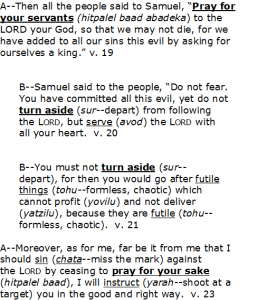
CHIASM, 1 SAMUEL 12:19-23
Explaining the Chiasm
Verses 19 and 23 share a phrase: hitpalel baad–“pray for your sake” or when followed by abadeka, “pray for (the sake of) your servants.” The theme here, therefore, is praying for others. Verses 20 and 21 also share a common word, sur, meaning to “turn from” or “depart.” What then does it mean to pray for someone else? Samuel provides an answer to this question, but perhaps not quite what many would have expected.
The conversation captured by this chiasm followed Samuel’s chastisement of the people for desiring a human king, all the while disregarding the rule of their rightful king–YHVH. In verse 12:7, Samuel told the people: “Now therefore stand that I may reason with you before the LORD all the righteous acts of the LORD that He did to you and to your fathers.” The word, reason, is the Hebrew, shaphat, meaning to judge. And the judgment was this: that though the LORD had acted on their behalf to bring them out of Egypt, “they forgot the LORD their God.” (1 Sam. 12:9) So the LORD sent judges (shoftim, meaning judges, the noun associated with shaphat) in the persons of Jerubbaal, Bedan (otherwise known as Balak), Jephthah and Samuel, who “delivered you from the hands of your enemies all around, so that you lived in security.” (1 Sam. 12:11)
The latest offense was Israel’s request for a king. “When you saw that Nahash the king of the sons of Ammon came against you, you said to me, ‘No, but a king shall reign over us, although the Lord your God was your king.” (1 Sam. 12:12) A chiasm just prior to the one we’re looking at demonstrated to the people that what they had done was wrong.
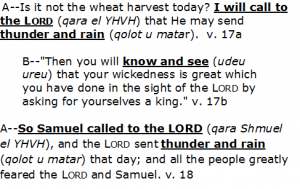
With this as a context, we now arrive at verse 19. The people, having witnessed the sign of the thunder and rain, now know and see that they have “added” (yasaph) to the evil sin they committed in requesting a king. They said to Samuel to pray for them (hitpalel baad) “so that we may not die.” And what prayer did Samuel pray? Did he fall to his knees, or face to the ground, and beg God to forgive Israel? His response started with two words: “Al tirau,” meaning “do not fear.” And he followed that with an instruction: “Do not turn aside (sur meaning depart) from following the LORD, but serve[1] (avod) the LORD with all your heart.” (v. 20) And in the very next breath, he again stated not to “turn aside, for then you would go after (achar) futile things.” What are futile things? In Hebrew, the word is tohu, the very same word found in Genesis 1:2–“the earth was tohu va bohu“–formless and void. In that same chapter, God made seven utterances–“vayomer Elohim“–and the world was brought into order. Man was then made in “the image of God”–tselem Elohim–with tselem pictographically meaning “the desire to control chaos.” Therefore, following the LORD brings order; departing or turning aside from the LORD brings tohu–chaos.
So, what was Samuel’s prayer? Did he go off somewhere to lift up his fellow Israelites to the LORD? There is nothing in this passage of Scripture bearing witness to anything like that. Rather, it simply states that Samuel resolved to instruct Israel in what was good and upright. And, if we take verses 20 and 21 into account, he told Israel not to “turn aside” from God, to follow the LORD, to serve the LORD with all their heart, to turn themselves toward the way and order of God, since to do otherwise would be “tohu“–chaos. That was Samuel’s palel–his prayer. Palal literally means to judge oneself, directing one’s heart and mouth to God. Samuel looked inside himself, aligned himself with the purpose for which God created man–the desire to control chaos–and issued a “call to action” for his fellow Israelites to do the same.
Is this what it means to pray for others? In the context of this Scriptural passage, yes. If this seems strange to us, it is because we are raised within the paradigm of associating prayer with its Latin root–precari, meaning entreat, ask or the bringing of a petition to God. Although this view of prayer–precari–has its own Biblical basis, to restrict our view of prayer to precari only narrows the means by which we enrich our relationship with God.
END NOTES
[1] This word, avod, meaning to serve or work, is first found in Genesis 2:5, “and there was no man to work the ground.” Man then is brought to life in Genesis 2:7. In Genesis 2:15, God put the man in the garden of Eden to avod (work), and keep (shamar–keep watch over) it.
]]>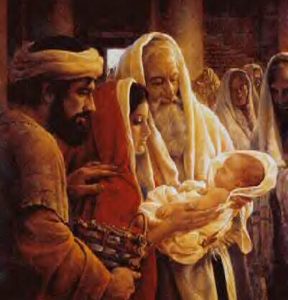
During a recent study on Judaism, a question arose regarding circumcision: why did God require it? We will carefully examine Scripture to attempt to discern the answer. Before that, in continuity with our study of Judaism, we’ll do a brief overview of circumcision among Jews today.
Although circumcision is practiced across all five, major Jewish denominations, it is not uniformly observed. Reform Judaism, for instance, encourages, but does not require, circumcision of non-Jewish converts.[1] Reconstructionist Jews advocate circumcision for converts, but often are lax in enforcing that standard. Secular Jews–50% of all Israeli Jews are secular and non-practicing–have no spiritual investment with religious rites surrounding circumcision, but in many cases, decide as a cultural matter to go forward with it as a ritual event.
Rabbinical literature attaches great importance to circumcision. In the Jerusalem Talmud–considered by the Rabbis to be the “oral law” spoken by God to Moses on Mount Sinai and transmitted by word of mouth throughout the ages–circumcision is said to be so important that it is “weighed against all the mitzvot” of the Torah.[2] Of course, it might be useful to know that there are 79 other instances in which various commands, practices and precepts are considered by themselves of equal importance to 612 commandments taken together. This includes the Shabbat, wearing of Tzitzit, the pursuit of peace, tsedakah (charity), and many others.
The word “circumcision” comes from Latin, circum (meaning “around”) and cædere (meaning “to cut”). So, combined, it means to “cut around.” The Hebrew term most closely associated with the practice of circumcision among Jews is brit milah. Brit means covenant. Milah means cut.
We now turn to the Scripture to entertain the question we started with: why circumcision? If we accept that the Scripture is a portal connecting us with God, our task becomes “drawing out” the meaning of the words of Scripture that, in the end, may answer our question from God’s point of view. To that end, we have at our disposal, as independent readers of Scripture, a set of literary tools. The ones that are most visible to us in English are chiasms and parallelisms. For a more thoroughgoing description of these types of literary arrangements, please reference Identifying Literary Structures in the Scriptures.
There are a number of Scripture passages in both Testaments touching on the subject of circumcision. Often, in tracing the meaning of a Biblical practice, we are wise to reference its Scriptural origin. This study will begin with Genesis 17, the first instance in which we find circumcision. The key verses in which God establishes the covenant of circumcision with the patriarch Abraham are 17:9-14. However, to capture the “context” of this covenant, let’s “widen” our reading, beginning with verse 17:3 and ending with the first line of verse 17.
3 Abram fell on his face, and God talked with him, saying,
4 “As for Me, behold, My covenant is with you,
And you will be the father of a multitude of nations.
5 “No longer shall your name be called Abram,
But your name shall be Abraham;
For I have made you the father of a multitude of nations.6 I will make you exceedingly fruitful, and I will make nations of you, and kings will come forth from you. 7 I will establish My covenant between Me and you and your [f]descendants after you throughout their generations for an everlasting covenant, to be God to you and to your descendants after you. 8 I will give to you and to your descendants after you, the land of your sojournings, all the land of Canaan, for an everlasting possession; and I will be their God.”
9 God said further to Abraham, “Now as for you, you shall keep My covenant, you and your descendants after you throughout their generations. 10 This is My covenant, which you shall keep, between Me and you and your descendants after you: every male among you shall be circumcised. 11 And you shall be circumcised in the flesh of your foreskin, and it shall be the sign of the covenant between Me and you.12 And every male among you who is eight days old shall be circumcised throughout your generations, a servant who is born in the house or who is bought with money from any foreigner, who is not of your descendants. 13 A servant who is born in your house or who is bought with your money shall surely be circumcised; thus shall My covenant be in your flesh for an everlasting covenant. 14 But an uncircumcised male who is not circumcised in the flesh of his foreskin, that person shall be cut off from his people; he has broken My covenant.”
15 Then God said to Abraham, “As for Sarai your wife, you shall not call her name Sarai, but Sarah shall be her name. 16 I will bless her, and indeed I will give you a son by her. Then I will bless her, and she shall be a mother of nations; kings of peoples will come from her.” 17 Then Abraham fell on his face and laughed, and said in his heart, “Will a child be born to a man one hundred years old? And will Sarah, who is ninety years old, bear a child?”
Looking at the beginning and ending of that passage, do you see items that repeat? Repeating words, phrases or ideas enable us to detect literary structures known as parallelisms, from which we will construct larger literary structures, chiasms.
We should immediately see “Abram fell facedown,” in line 3a vis-a-vis “Abraham fell facedown” in line 17a. This suggests the presence of a literary structure. Inside those verses, that is, after 3a and before 17a, are there other matching words, phrases and/or ideas?
What may next catch our attention is the “re-naming” of Abram to Abraham in verse 5 and Sarai to Sarah in verse 15b. There are two other similarities that follow this. Of Abraham, God states “I will make nations of you” in 6a paralleling “I will bless her (Sarah) so that she will be of nations.” (16b) Next, in 6b, we read of Abraham: “Kings will come from you.” Likewise, with Sarah, in 16b, we read: “Kings of peoples will come from her.”
We’re starting to connect the dots. Of Abraham and Sarah, nations will arise from them; kings will come from them. These declarations of God reveal His purpose for the couple. A genealogical path to David–and from there to Jesus–has been set into motion.
Returning to the literary structure, inside this matching set of parallelisms–Abraham falling facedown, the name changes, nations arising and kings coming forth–we find the key verses regarding circumcision. What in the world do any of these have to do with circumcision? It’s not immediately apparent, but the literary structure of the passage points to it.
Let’s focus on this aspect of naming. What is the significance of each change? The name, Abram, is a composite of two Hebrew words, ab meaning father, and rum meaning “to exalt.” So, taken together, we have “exalted father.” This word, rum, is used in the sense of lifting up, such as we find in Genesis 7:17–the “lifting up” of Noah’s Ark by flood waters, and in Genesis 14:22 in which Abram “lifts up” his hand to the LORD symbolic of swearing to an oath. The name, Abraham, includes ab meaning father, but combines it with an unused word–this has rendered the name of Abraham a bit mysterious. The latter half of verse 17:5 does say “I will make you a father of many nations.” The Hebrew for “father of many nations” is ab hamon goyim. This, we may surmise, connects to the meaning of the name, Abraham. And the name of Abraham is connected to the rise of nations and the coming forth of kings.
The names Sarai and Sarah derive from the same root, sar, meaning princess. Both names mean, essentially, the same thing. As with Abraham, the text associates the name of Sarah with the rise of nations and the coming forth of kings.
To see the importance to God of these name changes, and to connect them in some way with circumcision, we need to look back in Scripture to earlier points of time. Where do we find the first reference to naming?
We find the initial reference to naming in Genesis Chapter 2. Before going into that bit of detail, I believe it’s worthwhile to locate its context within the entire story of the creation of man. We may detect a pattern that will inform the naming discussion. This initial story begins in Genesis 2:7: “And the LORD God formed man of the dust of the ground, and breathed into his nostrils the breath of life; and man became a living being.” God formed, that is, created man from the dust of the ground, that is, with the help of His creation. So, God was the primary actor here, the creation, secondary, that which was used by God to create a man. Is there a verse that parallels this? It turns out there is: Genesis 4:1, which I would consider the end of the story. “Now the man knew his wife, Eve, and she conceived and gave birth to Cain, and she said, ‘I have acquired a man with the LORD.'” In Hebrew, the word translated as “with” is et. When this word shows up in front of a noun, that noun becomes a direct object. Therefore, the LORD is the direct object and is One who Eve “used” to acquire Cain. Eve is the primary actor here, the subject, and the LORD is secondary, the object. In Genesis 2:7, God created a human being with the help of His creation, the earth. In Genesis 4:1, a human being created a human being with the help of God. In between, something has significantly shifted.
Between 2:7 and 4:1, another parallelism presents itself. In 2:25, we read: “The man and his wife were both naked, and were not ashamed.” The Hebrew for “ashamed” is boosh, meaning “aware.” The man and his wife were not “aware” of their nakedness; they had no self-awareness. Is there a verse that parallels this. Yes, verse 3:7a. “Then the eyes of both of them were opened, and they knew that they were naked.” The first humans became self-aware.[3] This occurred immediately after eating the forbidden fruit. For discussion purposes, we will call everything that transpired before eating the “pre-tree” world and everything after eating the “post-tree” world. A literary structure has emerged.
Inside both the “pre-tree” and the “post-tree” worlds, there are naming events. Do you see them? In Genesis 2:19, we read: “Out of the ground the Lord God formed every beast of the field and every bird of the sky, and brought them to the man to see what he would call them; and whatever the man called a living creature, that was its name.” At this point, Adam had no “self-awareness.” He existed in the pre-tree world. He only had “God-awareness.” So, whatever he called each animal “that was its name.” Those names aligned with the purpose and will of God–they would be unchanging. Adam was not acting independently of God. What is the other naming event?
We find that in Genesis 3:20. “Now the man called his wife’s name, Eve, because she was the mother of all the living.” In Hebrew, Eve is called Chava. It is a derivative of the word, chay, meaning life. She is called “em kol chay,” mother of all life. Where is it that we find this verse? In the post-tree world. It follows immediately after God has told Adam “for you are dust, and to dust you shall return.” Is this what you’d say or do after hearing those words from the Creator of the Universe? When God spoke to Adam, Adam spoke back, almost as if he was some sort of equal. When God spoke to Abraham, Abraham fell facedown. Two verses later, God stated: “Behold, the man has become like one of Us, knowing good and evil.” Verses 2:19 and 3:20 form an antithetical parallelism–in 2:19 a human being names the animals according to the purpose for which God created them–“and that was its name.” In 3:20, a human being names another human being, but there is no qualifier, nothing saying “and that was its name.” In addition, God authorized Adam to name the animals, bringing them to him “to see what he would name them.” In verse 3:20, Adam just names Eve without prior authorization–he acts independently. God started as the sole Creator of the living: and the LORD “breathed into his nostrils the breath of life.” (Gen. 2:7) That was pre-tree. Now, a human being is the “mother of all the living,” post-tree. (Gen. 3:20) The verse following 3:20 is also very telling: “The LORD God made garments of skin for Adam and his wife, and clothed them.” Is there a prior verse that parallels that? Yes–verse 3:7: “Then the eyes of both of them were opened, and they knew that they were naked; and they sewed fig leaves together and made themselves loin coverings.” It happens that the making of loin coverings was the first and only act of “creating” done by human beings to this point in the narrative. And when Adam named Eve according to a purpose he assigned to her–“mother of all the living”–the very next thing God did was to create garments. If Adam and Eve purposed to be creators in their own right, to independently create something, and if the one and only thing they created was loin coverings, God was quick to assert His position as Creator of the universe, as the Creator of all, by producing His own coverings for the couple, by reasserting human dependence upon Him. This was not simply “gracious” as it is often sermonized; this was a reminder to the couple that God was the ultimate Creator, the sole independent Being in all existence. And just four verses later, the one whose name means “mother of all the living” looked at herself as the primary creator of a human being, an independent creator who used God for her purpose. A shift has occurred from God-centeredness to human centeredness. Wow.[4]
There is another incident, just before the time of Abraham, that embraces both the matter of names and the “shift” from God-centeredness to human-centeredness. Genesis Chapter 11 records the story of Babel. A question we might ask is why is this story found in this place of Scripture? Take note that just before that story, in Chapter 10, beginning in verse 21, we have the genealogy of Shem, the first son of Noah. Then comes the account of Babel. Immediately following that account is a second telling of the genealogy of Shem, beginning in verse 11:10. The latter genealogy leads all the way to Abram, something the version in chapter 10 does not do.
Shem, in Hebrew, means name. It consists of two Hebrew consonants, shin and mem. The first use of a word with only those two consonants is in Genesis 2:10: “Now a river flowed out of Eden to water the garden; and from there it divided and became four rivers.” Did you see it? The word spelled shin-mem, or shem, translates the English “there.” “From ‘there’ it divided.” Shem, that is, name, references the source of something. Looking back to Genesis 2:7, God was the “source” of life; in 3:20, Eve, being named by Adam, the “mother of all the living,” was deemed by him as the source of all life.
Is there something in the account of Babel mentioning the word, name? Yes, in verse 11:4: “They said, ‘Come, let us build for ourselves a city, and a tower (migdal from gadal meaning great) whose top (rosh) will reach into heaven, and let us make for ourselves (Heb.: la-nu) a name (shem).” They, the men of Babel, set as their purpose to build a “great” tower to make for themselves a “name.” This “name” they strived for was a “source” of self-identity. God frustrated these plans by confusing their language and scattering them across the face of the earth. The imagery here is that the great identity of man–this name–was dispersed over the earth, made small as if to vanish. The purpose of men was not in alignment with the purpose of God.
And what then did God do? After introducing the name of Abram within the second genealogy of Shem in Chapter 11, God converses with Abram in Chapter 12. The first genealogy of Shem represented a lineage operating according to man’s purpose and leading to Babel; the second was a lineage according to God’s purpose, leading to Abram, then to David, and ultimately to Christ. The first genealogy of Shem–and in Chapter 10, the other two sons of Noah–led to the mistaken idea that human beings could, of their own efforts, build a tower into heaven. The second genealogy of Shem leads to Abram, through whom God will redirect his self-centered creation back to Himself. And when God spoke to Abram, He told him: “And I will make you a great (gadal) nation, and I will bless you, and make your name (shem) great (gadal).” (12:2) It is not for man to purpose to build “great” towers to reach into heaven. Rather, it is for God to make “great” nations. It is not for men to make a name for themselves, to be the “source” of their own greatness–to make their own name great; rather it is God with whom the purpose of man is identified, and it is God with whom man is aligned. It is God, not man, who makes a name great.
How does this then find its way into understanding Genesis 17? When God renamed Abram and Sarai–humanly-given names–to Abraham and Sarah–names assigned by God Himself, it signaled His purpose to bring mankind back to Himself. Abraham and Sarah would become the “source” of nations and kings. A creation that dared to name its first woman, the mother of all the living, now would return its actual source of life, its Creator, the LORD. How do we know this? And does this, in some way, connect to circumcision?
There are two literary structures in Genesis 17 that point to this conclusion. Here is the first:
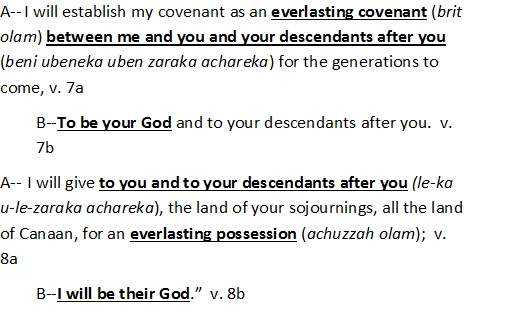
In line 7a, God proclaims a covenant between Himself and Abraham, including Abraham’s descendants: “I will establish my covenant as an everlasting covenant (brit olam) between me and you and your descendants after you (beni ubeneka uben zaraka achareka) for the generations to come.” This parallels a statement in line 8a, “I will give to you and to your descendants after you (le-ka u-le-zaraka achareka), the land of your sojournings, all the land of Canaan, for an everlasting possession (achuzzah olam);” This is a synthetic parallelism–line 7a offers a covenant in general terms, line 8a “amplifies” or “expands” on it by revealing the specifics. This reiterates the covenant regarding the inheritance of land promised to Abram in Chapters 12 and 15. In conjunction with this–and importantly just before the covenant of circumcision–are lines 7b and 8b, in which God asserts that He will be “your God and (God) to your descendants after you.” God is bringing His people to a land where He will redirect them to Himself. It is through Abraham and Sarah, freshly renamed, that God will purpose a “new beginning” for mankind.
The second additional literary structure goes from verse 10 through verse 12. It centers specifically on circumcision, and like its previous counterpart, is located between the naming of Abraham and Sarah and God’s purpose for them.
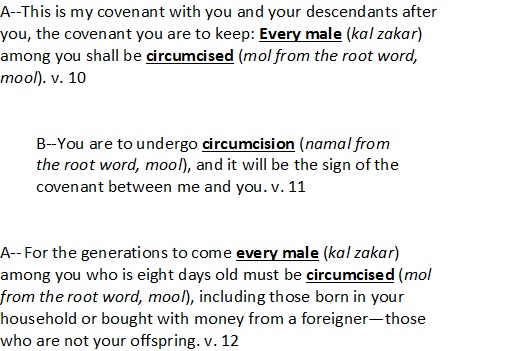
Verses 10 and 12 are, like lines 7a and 8a, synthetic parallelisms. Verse 10 states that all males (kal zakar) will be circumcised. Verse 12 expands on that by stating that this will occur on the eighth day after birth[5], not only to Abraham’s offspring but also to those “who are not your offspring” but attached to the household. At the center of this chiasm, Abraham is specifically instructed to undergo circumcision “and it will be the sign of the covenant between me and you.” (v. 11)[6] The word in Hebrew for sign is oht, meaning a mark.[7] This same word is used in Genesis 4:15 in reference to Cain. It is also found in Genesis 9:12, 9:13 and 9:17, in reference to the rainbow that God would set in the sky as a “sign” of His covenant with Noah by which God promised never to destroy the earth by flood. So, if the rainbow is the sign of a covenant not to destroy the earth by flood, what is circumcision the sign for?
To discern a reason within Scripture, we begin with examining the word zakar. In our last literary structure, this word was translated as “male” in both verses 10 and 12. And those verses stand in parallel with each other, each authorizing/commanding the practice of circumcision. The Biblical author could have used the word, ish or adam, to refer to a man, or ben to refer to a son, but instead used zakar–male. The etymology or origin of this word traces back to the act of remembering, also zakar in Hebrew. This is true of a comparable word in Arabic, another language belonging to a larger circle of people known as Semites, descendants of Shem, the son of Noah, whose name, in turn, means name. The act of remembering, from the standpoint of its original meaning, is an act of pointing toward something that is not physically present.
Circumcision is intimately tied to the act of remembering. The mark of circumcision, every time it’s seen, points to something not physically present–alas, to Someone not physically present–to God. This is a means by which God “redirects” man to Himself. Although the sign of circumcision resides on the instrument of a man’s creativity, it serves as a reminder that even he who can create here on earth was himself created by Someone else, the LORD our God.
ENDNOTES
[1] As early as the second century B.C., Jewish sages differed on the necessity of circumcision during the conversion process. The Talmud records that R. Eliezer ben Hyrcanus required both circumcision and immersion in a mikveh; R. Joshua, on the other hand, only required immersion. 19th-century Reformers advocated to prohibit circumcision on the grounds that it was both unhealthy and barbaric, an unnecessary vestige of an ancient, outdated practice. (www.jewishvirtuallibrary.org)
[2] “The covenant of circumcision is of such great import that its observance takes precedence even over the Shabbat. This is perhaps due to the fact that by performing circumcision one actively accepts the very covenant one passively demonstrates by not doing the work activities (“melachot”) of Shabbat. Indeed, whereas one rests on Shabbat to identify with the Creator, so one performs brit milah to identify one’s active partnership with the Creator.” (Equal to All the Mitzvot in the Torah, Rabbi Mois Navon, Aish.com)
[3] This is further indicated by the question of God to Adam in v. 11: “Who told you that you were naked?” This would indicate that Adam would not have been previously aware of his nakedness unless God told him.
[4] In Genesis 2:2-3, it states that God rested from His work. The Hebrew used here for work is melachah. In Genesis 2:15, it states that God took Adam and put him in the garden to work and keep it. The word, work, in Genesis 2:15 is avodah. Melachah is used in Hebrew to describe “creative” work whereas avodah is simple laboring or tending. Man was, therefore, not placed on Earth to independently create, but rather to tend the work of his Creator. Jesus said: “For I have come down from heaven, not to do My own will, but the will of Him who sent Me.” (John 6:38)
[5] There is no explanation in Scripture for performing the circumcision on the 8th day. In Rabbinical literature, it was held that a Sabbath must pass before circumcision could occur. Therefore, if a baby boy was born on the Sabbath, it would be eight days before a full Sabbath had passed. It is reasoned that “the holiness of the Sabbath comes directly and exclusively from God. . .once the baby has experienced the ‘holiness’ of the Shabbos, he may enter into the covenant of the Jewish people.” (www.aish.com/ci/sam/48964686.html)
[6] Jewish tradition holds that “Adam was born without a foreskin. Only when he sinned did he create a barrier between himself and God and at that point developed a foreskin. The removal of t he foreskin represents the physical act by which man attempts to come close to God again.” (www.aish.com/ci/sam/48964686.html)
[7] R. Hirsch (Ber. 17:10, p.301) explains that the sign (“oht”) of circumcision symbolizes complete submission to the authority of God, such total compliance being indicative of serving God in awe (“yareh”). Hence, the relationship occurs between this response and Abraham falling facedown.
]]>
One of the primary critiques of Catholicism issued by Protestants is that Catholic parishioners are often discouraged from reading and interpreting the Scriptures on their own. The critique contends that the priests handle this on behalf of the flock. A Protestant who simply carries a Bible around mirrors the Catholic he critiques if he relies completely on his pastor to read the text for him and supply all of the interpretation. If self-reading/interpretation is the goal, then training in how to read the Scripture is essential for establishing our ability to interpret it.
The Old Testament is considered to be roughly 75% Hebraic poetry. There are literary features of Hebrew poetry that escape the eye of even the most experienced English reader who does not have a knowledge of the Hebrew language underlying his English translation. One such feature is an alphabetical acrostic. This format provides that each successive line, half-line or verse begins with a letter of the Hebrew alphabet in alphabetical order. Poetically, this is a method of saying that the text completely covers everything in terms of its topic from A to Z, so to speak, or in Hebrew, from Aleph to Tav. Psalm 111, for instance, begins each of its 22 lines with one of the 22 Hebrew letters in the order in which they appear in the Hebrew alphabet. Proverbs 31:10-31 is often called “The Excellent Wife.” It consists of 22 verses, each one beginning with one of the 22 Hebrew letters, again in order.
Alliteration derives from the Latin, “latira,” meaning “letters of alphabet.” An alliteration is a stylistic device in which a number of words, found closely together in a sentence, either begin with the same letter or letters or with the same sound. In the rhyme, Better Botter by Carolyn Wells, we have a tongue-twisting example: “Betty Botter bought some butter, but she said, this butter’s bitter; if I put it in my batter, it will make my batter bitter, but a bit of better butter will make my bitter batter better…” In English, Scripture’s first few words are “In the beginning, God created. . .” (Gen. 1:1) However, in Hebrew, it is: “Bereishit bera Elohiym. . .” Bereishit and bera both begin with the letters bet (the Hebrew B) and reish (the Hebrew R), and thus are alliterative.
Another feature of Hebraic poetry that is slightly easier to discern in English translations, but still largely hidden from view, are wordplays, including word puns.[1] A word pun is a play on words in which, for instance, similar sounding words (with similar roots) repeat with different meanings.[2] It is common, for instance, in the Hebrew Scriptures, for the names of Biblical characters to be fashioned after words that give meaning to the nature of the character himself. For instance, Adam is taken from the word, adamah, meaning “ground” since he was formed from the dust of the “ground” (adamah). (Gen. 2:7)[3] Eve’s Hebrew name, Chavah, derives from the word, chay, meaning life, “because she was the mother of all living.” (Gen. 3:20)[4] In Genesis 2:25, we learn that the first man and woman were naked–arumim–and in the very next verse, the snake is described as “clever”–arum. Arumim and arum are similar sounding words built on the same root word, arom (spelled ayin-reish-mem), but meaning different things in the context of the Biblical text. Moving forward into the Genesis story, we have Isaac, named Yitzhak in Hebrew, which is a play on the verb tzachak, meaning to laugh, for when God told Abraham of his 90-year-old wife, Sarah, that “kings of peoples will come from her, Abraham fell facedown and laughed (tzachak).” (Gen. 17:16-17)[5] Later in the story of Isaac, the wordplay of Isaac to laughing, or in Hebrew, yitzhak to tzachak, continues. Isaac, like his father, Abraham, was guilty of telling people that Rebekah, his wife, was his sister. In Genesis 26, Isaac made this claim to the people of Gerar. (Gen. 26:7) In the NIV version of events, their king, Abimelech, “looked down from a window and saw Isaac caressing Rebekah his wife.” (Gen. 26:8) The root of the word translated as caressing is tzachak. So, in Hebrew, Isaac caressing reads “Yitzhak tzachak,” or Laughing was “laughing” with Rebekah, his wife. In this case, the NIV translators spotted this play on words, and translated the word tzachak to mean “caressing” or an act of lovemaking, a potentially better fit for the context of the story.
Another word pun occurs during the story of the person of Joseph. In Genesis Chapter 40, two servants of the king of Egypt, a cupbearer and a baker, were thrown into the prison where Joseph was also confined. There, they both had dreams. Joseph was called upon to interpret them. The cupbearer’s dream involved three branches. “This is what it means,” Joseph said to him. “The three branches are three days. Within three days Pharaoh will lift up your head and restore you to your position, and you will put Pharaoh’s cup in his hand, just as you used to do when you were his cupbearer.” (Gen. 40:12-13) The chief baker’s dream involved three baskets of bread. “This is what it means,” Joseph said. “The three baskets are three days. Within three days Pharaoh will lift up your head from you (may-ah-leh-cha) and impale your body on a pole.” (Gen. 40:18-19) Did you notice the repeating words in verses 13 and 19? In Hebrew, “Pharaoh will lift up your head” is “yissa Paroh et rosheka“–in verse 13 indicating a good result, and in verse 19, a bad one.
Hebrew word puns can also be discerned in certain books of the New Testament, particularly the Book of Matthew. Although there are no existing Hebrew manuscripts that can be traced back to the 1st Century C.E., there are many who contend that the Book of Matthew was originally written in the Hebrew language. The basis for this understanding is the testimony of a number of early Church fathers.
“Matthew put down the words of the Lord in the Hebrew language, and others have translated them, each as best he could.”—Papias, mid-2nd Century A.D.
“Matthew, indeed, produced his gospel written among the Hebrews in their own dialect.”—Irenaeus, (120-202 A.D.)
“The first [gospel], composed in the Hebrew language, was written by Matthew. . .for those who came to faith from Judaism”—Origen, (first quarter of the third century)
These quotes were recorded by Eusebius, a Roman historian, in his book Ecclesiastical History. who would later become the Bishop of Caesarea in Palestine in 314 A.D. He made his own comment below:
“Matthew had first preached to the Hebrews, and when he was about to go to others also, he transmitted his gospel in writing in his native language.”
Among the later Church fathers (post-Nicean from 325 A.D.), we have the following:
“They have the entire Gospel of Matthew in Hebrew. It is carefully preserved by them as it was originally written, in Hebrew script.”—Epiphanius, Refutation of All Heresies.
“Matthew was the first in Judea to compose the gospel of Christ in Hebrew letters and words. . .Who it was that later translated it into Greek is no longer known with certainty. Furthermore, the Hebrew text itself is still preserved in the library at Caesarea which the martyr Pamphilus assembled with great care.”—Jerome, De Viris Inlustribus 3
Discerning Hebrew word puns in the Matthean text lends strength to this position. Here are several examples:
1) When Jesus healed a paralytic in Chapter 9, we read: “When the crowds saw it, they were afraid, and they glorified God, who had given such authority to men.” (Matt. 9:8) The Greek words used for “saw” (idontes) and “were afraid” (ephobethesan) have no apparent connection to each other as figures of speech. However, when the verse is translated into Hebrew, those two words, saw and were afraid, are found to be homonyms, both pronounced “vayir’u,” though originating from two different root words, ra-ah (r-h) for saw, and yare (y-r) for afraid.
2) In Matthew Chapter 3, when John the Baptist “saw many of the Pharisees and Sadducees coming to where he was baptizing,” he made a declaration to them, part of which states: “And do not think to yourselves, ‘We have Abraham as our father.’ I tell you that out of these stones God can raise up children for Abraham.” (Matt. 3:9) In Greek, the word used for stones is lithon, and the word for children is tekna. There is no phonetic or word play connection between those words. However, when translated into Hebrew, those words become ebenim (stones) and benim (children). They are closely related phonetically, and in fact, rhyme, connecting the meaning of stones and children in a very intimate and “easy to remember” way that the corresponding Greek words do not.
3) In Matthew 16:18, we have a Greek word play: “And I tell you, you are Peter (Petros), and on this rock (petra) I will build my church, and the gates of hell shall not prevail against it.” Petros is a Greek name meaning rock or small stone, and petra also means rock, as in a large rock. Both words are similar sounding and have a similar meaning. At the same time, there is also a word play in the Hebrew translation: : “And I tell you, you are Peter, and on this rock (eben) I will build (ebneh) my church, and the gates of hell shall not prevail against it.” In Psalm 118:22, we see a similar pun: “The stone (eben) that the builders (bonim) rejected has become the cornerstone.” (eben/bonim) This word pun is repeated by Jesus in Matthew 21:42: “Jesus said to them, “Have you never read in the Scriptures: “‘The stone (eben) that the builders (bonim) rejected has become the cornerstone; this was the Lord’s doing, and it is marvelous in our eyes?” The corresponding Greek for stone (lithon) and “those building” (hoi oikodomountes) or builders (oikodomos) are not word plays.
4) In Mark, Chapter 4, we read: “The Kingdom of God is as if a man should scatter seed on the ground.” (Mark 4:26) In Greek, we have the following words: anthropos (man), bale (scatter), sporon (seed) and ges (ground). None of these Greek words relate to each other phonetically or as figures of speech. In Hebrew, however, we see two pairs of very similar words: adam–man links to adamah–ground; zara–scatter and zera–seed. The second pair is encased within the first pair. Together we have: adam–zara–zera–adamah.
Parallelisms
Other literary features are much more easily identified by the English reader. Among these are parallelisms. A parallelism displays a relationship of two or more lines/verses of text to each other. Thoughts repeat, sometimes in the same way–a synonymous parallelism, other times in a contrasting way–an antithetical parallelism, other times the second line reinforces/adds to the first or explains the who, what, where, why, or how of the first–a synthetic parallelism. There are other types of parallelisms–climactic, eclectic, emphatic–but for now, the first three types are the forms we’ll be dealing with. Here are some examples:
“There is no speech, nor are there words.” (Ps. 19:3) (Synonymous)
” The law (torah) of the LORD is perfect, restoring the soul; the testimony of the LORD is sure, making wise the simple.” (Psalm 19:8) (Synonymous)
“Your word is a lamp to my feet and a light for my path.” (Ps. 119:105) (Synonymous)
“Lamech said to his wives, “Adah and Zillah, listen to me; wives of Lamech, hear my words.” (Gen. 4:23) (Synonymous)
“For everything there is a season, and a time for every matter under heaven.” (Eccl. 3:1) (Synonymous)
“The heart of the wise inclines to the right, but the heart of the fool to the left.” (Eccl. 10:2) (Antithetical)
“He who keeps the commandment keeps his soul, But he who is careless of conduct will die.” (Prov. 19:16) (Antithetical)[6]
“A time to be born, and a time to die; (Eccl. 3:2a) (Antithetical)
a time to plant, and a time to pluck up what is planted.” (Eccl. 3:2b) (Antithetical)[7]
“Fire goes before Him, and burns up His adversaries round about.” (Ps. 97:3) (Synthetic–what fire does)
“The sacrifice of the wicked is detestable –how much more so when brought with evil intent!” (Prov. 21:27) (Synthetic–evil intent adds to wickedness)[8]
In Part 2, we will move on to the study of chiasms.
ENDNOTES
[1] In ancient Israel, and up until the invention of the printing press in the Renaissance period, the written words of the Scripture were largely unavailable to the masses. Most people throughout their generations received the word by oral transmission. “Then Moses commanded them, saying, “At the end of every seven years, at the time of the year of remission of debts, at the Feast of Booths, when all Israel comes to appear before the LORD your God at the place which He will choose, you shall read this law in front of all Israel in their hearing.” (Deut. 31:10-11) The messages of the Gospels were shared orally for decades before they were committed to writing. The word pun, in light of this, was an extremely useful method for securing the remembrance of the Scriptures that were only read or shared by voice.
[2] Examples of puns in English: “Time flies like an arrow. Fruit flies like a banana.” “When a clock is hungry it goes back four seconds.” (The word “four” is a homonym of “for” but means something different. “A chicken crossing the road is truly poultry in motion.” Poultry sounds like poetry, but poetry is not like a chicken.
[3]” And God formed the man (adam) from the dust of the ground (adamah).” Gen. 2:7
[4] “The man called his wife’s name Eve (Chavah), because she was the mother of all living (chay).” (Gen. 3:20)
[5] Then Abraham fell on his face and laughed (tzachak), and said in his heart, “Will a child be born to a man one hundred years old? And will Sarah, who is ninety years old, bear a child?” And Abraham said to God, “Oh that Ishmael might live before You!” But God said, “No, but Sarah your wife will bear you a son, and you shall call his name Isaac (Yitzhak); and I will establish My covenant with him for an everlasting covenant for his descendants after him. (Gen. 17:17-19)
[6] Charles Dickens also used a string of antithetical parallelisms to open his novel, A Tale of Two Cities: “It was the best of times, it was the worst of times, it was the age of wisdom, it was the age of foolishness, it was the epoch of belief, it was the epoch of incredulity, it was the season of Light, it was the season of Darkness, it was the spring of hope, it was the winter of despair, we had everything before us, we had nothing before us, we were all going direct to Heaven, we were all going direct the other way. . .”
[7] Each half-line of Eccl. 3:2a and 3:2b is antithetical to its corresponding half (born/die, plant/pluck), but each line, taken as a whole, is synonymous to its corresponding line.
[8] 6 Jesus said to him, “I am the way, and the truth, and the life. No one comes to the Father except through me. 7 If you had known me, you would have known my Father also, From now on you do know him and have seen him.” (John 14:6-7) (Synthetic–how do we come to the Father? We come to know the Father through knowing his Son, Jesus)
]]>
This study continues a series of studies conducted by Pastor Terry Austin on world religions. Judaism, based on an historical and cultural heritage spanning roughly 3000 years, is impossible to comprehensively cover in the space of a single lesson. The audience for this lesson, mostly being non-Jewish, arrives at this study with impressions of both Jews and Judaism formed by Biblical studies, facts/opinions gleaned from readings and/or the media, and personal interactions with Jewish friends, acquaintances and organizations. With this in view, the goal is to narrow down the possible range of topics to a manageable few, while still providing an overview of the demographics of the Jewish population and its religious subsets. Since there can be no Judaism as a living faith without the presence of Jewish practitioners, the question, “Who is a Jew,” seems to me to be an appropriate starting point.
Who is a Jew?
There are estimates that indicate the worldwide Jewish population to be between 13.75 to 17.4 million. Why the difference? Because it depends on who’s doing the counting and what their definition of a Jew is.
The word, Jew is, in Hebrew, Yehudi. It derives from the name of Judah, the fourth son of the patriarch, Jacob, and ancestor of the tribe of Judah. Judah is pronounced Ye-hud-ah in Hebrew. Yehudah finds its verbal root in the word, yadah, meaning to confess, give thanks or give praise. Therefore, the word, Jews, can be understood to mean a “people of praise.”
The designation of Yehudim, that is, Jews, to members of the tribe of Judah expanded following the division of the nation of Israel after the death of King Solomon. The Kingdom of Judah emerged, incorporating tribal members not only from Judah, but also from the tribes of Benjamin and Levi. All these were considered Yehudim. In Esther 2:5, we find the person of Mordecai, the cousin of Esther, described both as a Yehudi and as a Benjamite.
All Israel claims to be descended from the patriarchs: Abraham, Isaac and Jacob. The descendants of Judah–since they are among the tribes of Jacob–share in this claim. They partake of the promises of God to the Patriarchs–“I will make you a great nation,” (Gen. 12:2) “In you all the families of the earth will be blessed.” (Gen. 12:3) “To your seed,” said God to Abram, “I have given this land.” (Gen. 15:18) To Isaac, God said: “I will multiply your descendants as the stars of heaven, and will give your descendants all these lands; and by your descendants all the nations of the earth shall be blessed.” (Gen. 26:5) They are also parties to covenants with God. “This is My covenant,” God declared to Abraham, “which you shall keep, between Me and you and your descendants after you: every male among you shall be circumcised.” Through Moses, God said: “If you will indeed obey My voice and keep My covenant, then you shall be My own possession among all the peoples, for all the earth is Mine; and you shall be to Me a kingdom of priests and a holy nation.” (Ex. 19:5-6) To which “all the people answered together and said, ‘All that the LORD has spoken we will do!'” This would come to include the observance of “appointed times” (moedim) in which the people are called upon to “meet with God,” as well as a corpus of 613 commandments (mitzvot) found in the Torah, God’s “instruction.” Although genealogy, as already indicated, can play a role in becoming a Jew, even those outside the lineage of Judah, or outside the lineage of Israel itself, can become Jews. Take, for example, the person of Ruth. In Chapter 1 of the Book of Ruth, Naomi, a Judean and the mother-in-law of Ruth, contemplated returning to Judah from the nation of Moab following the death of her husband and two sons. Naomi tried to dissuade Ruth, a Moabite by birth, from following her back to Judah to which Ruth responded: “Do not urge me to leave you or turn back from following you; for where you go, I will go, and where you lodge, I will lodge. Your people shall be my people, and your God, my God.” (Ruth 1:16)
From this, we build the understanding that Scripture provides a fairly straightforward approach to defining a Jew: a person self-identifies as a Jew by claiming an attachment to the promises made to the Patriarchs, abiding by the covenants entered into by the Patriarchs (i.e., the Abrahamic covenant and the covenant of circumcision), observing the terms of the covenant made between God and the people of Israel on Mount Sinai that would include keeping the appointed times and lifestyle choices (i.e., eating kosher [Kashrut], laws regarding purity [Niddah]), identifying the people of Israel as one’s own, and perhaps most importantly, adopting the God of Israel as one’s own.
It all seems so simple. . .until it ceases to be so simple. Today, there exist five major branches of Judaism: Orthodox, Conservative, Reform, Reconstructionist and Karaite. We will compare their answers to the question, “Who is a Jew,” alongside the position of the State of Israel (in the context of the Law of Return) and the view of the anti-Semitic movement, Nazism.
Orthodox Judaism
I did the majority of my Jewish study as a youth, including my Bar Mitzvah, in an Orthodox synagogue. At the time, I had no idea what “orthodox” meant–which, as it works out, is probably very much like the experience of every Jew until the beginning of the 19th century. What we today call Orthodox Judaism, arose in response to the advent of Reform Judaism, wrapping itself in the ways and traditions of Jews dating back into antiquity, though the ancients would not have called themselves “orthodox” per se. Orthodox Judaism is an umbrella term covering a number of groups, most prominently Modern Orthodox Judaism–a movement that preserves traditional understandings but seeks to embrace modernity, to Haredi Judaism–an ultra-Orthodox community that rejects modernity, tightly embracing Jewish laws and customs and regarding itself as the most genuinely authentic group of Jews. Chasitic Judaism is a subset of Haredi Judaism.
The Berkley Center for Religion, Peace and World Affairs at Georgetown University published a demographic study in 2017 showing that 22% of all Jews residing in the U.S. identify as Orthodox, the third largest denomination. In Israel, 15-20% of all Jews self-identify as either Orthodox or Ultra-Orthodox (Haredi/Chasitic), compared to 35% non-denominationally religious and 50% secular.
All Orthodox Jews share the ancient Pharisaic view of two Torahs, one Written and the other Oral. The Oral Torah is considered to have been given by God to Moses on Mount Sinai, passed down by word of mouth from generation to generation, and ultimately compiled into writing, beginning in the 2nd Century C.E. Both the written and oral Torahs are regarded by Orthodox Jewry as equally authoritative. The written compilation of the Oral Torah–known as the Talmud–has two parts: the Mishnah and the Gemara. The word, Mishnah, derives from the Hebrew, shanah, meaning “to repeat.” So the word itself is understood to mean to “study by repetition.” Within this book are two different kinds of literature, one of which is halakah. Halakah derives from the Hebrew root, halak, meaning “to walk.” It can also mean a “way” or “path.” It brings together under one heading laws found in the Torah (both oral and written), rules instituted by the rabbis (takanot and gezerot), as well as customs (minhagim).[1] The other literary form is aggadah (“telling”), consisting of “wise sayings,” stories, parables and homilies. The Gemara consists of oral discussions between ancient rabbis concerning the reading and application of the teachings in the Mishnah. And it is in the Talmud, within the halachot, that Orthodox Judaism finds its means of answering “Who is a Jew?”[2]
In Orthodox Judaism, across all streams, a Jew is regarded as someone born to a Jewish mother. The genealogy is, therefore, matrilineal. The background of the father is irrelevant insofar as determining if the child is a Jew. Also irrelevant is whether the child self-identifies as Jewish. Neither the mother nor the child need to practice any of the commandments nor do they have to observe any of the appointed times (moedim/holidays). Orthodox believers cite the Talmud, tractate Kiddushin 68b, in support of this view. The tractate references Deuteronomy 7:3-4, regarding intermarriage between Gentiles and Israelites. Insofar as a marriage between a Gentile male and an Israelite female is concerned, the text of 7:4 reads: “For they (the Gentile males) will turn your (the Israelite females) sons away from following Me to serve other gods.” Therefore, the rabbis reasoned that the “sons” who would turn away from God began as Israelites. They also deduced that since the text did not address a situation involving a Gentile mother, an Israelite son could only belong to an Israelite mother. A Jew, being an Israelite, would be subject to the same reasoning.
The Tanakh makes no explicit statement supporting matrilineal descent.
With regard to conversions, again the halacha of the Talmud is the guide. A bet din (Hebrew: house of judgment, a court) consisting of three Jewish males, usually Orthodox rabbis, oversees that the following requirements are met:
1) Male circumcision. If already circumcised, a small drop of blood will be taken (hatafat dam, hatafat means drop, dam means blood, first used in Genesis 4:10 regarding the blood of Abel).
2) Immersion in a Mikveh (a running body or natural pool of water) for both men and women. This symbolizes the acceptance of the Torah in one’s life.
3) Accepting the “yoke of the commandments.” This means all of them.[3]
Conservative Judaism
At first glance, this would seem to indicate that this branch is to the conservative side of Orthodox. That’s not the case, though having attended Shabbat services in Conservative synagogues as a youth, I did not observe a great deal of difference (perhaps I was more interested in the food after the service![4]). More than likely, this is because Conservative Judaism accepts the binding nature of halacha (written/oral Torah; rabbinical edicts, customs). However, it departs from the Orthodox movement, to a greater or lesser degree depending on which stream of Orthodoxy we’re looking at. Conservative Jews recognize the divine nature of Torah, but add that there are human influences in its writing. They also lean toward the belief that the law should adapt to modern, cultural influences. For instance, women and men sit together and participate fully during synagogue services whereas in Orthodox services, they are separated. Conservative Judaism, like Orthodox Judaism, officially disapproves of homosexuality. As of 1985, women can be ordained as rabbis. In 1960, it was agreed that using electrical appliances and driving a car on the Sabbath are permitted. There are degrees to which strict adherence to halacha (or departure from it) applies also–many Conservative synagogues are almost indistinguishable from their Orthodox counterparts while others lean toward the more liberal, Reform movement.
Conservative Judaism grew out of a dissatisfaction with both the Orthodox and Reform movements, occupying what it sees as a “middle ground” between the strict halachic approach of the Orthodox and the non-halachic approach of the Reform. It traces its theological genesis into 19th century Europe, it reached the United States in 1883, and it is here that it claims most of its following. Conservative Judaism is the second-largest U.S. denomination at 33 percent. There is a comparable movement in Israel known as Masorti Judaism (Masorti meaning “traditional” or “conservative” in Hebrew).
Like its Orthodox counterpart, Conservative Judaism defines a Jew as one of matrilineal descent. Conversion also follows the pattern of the Orthodox movement. However, because Conservative Judaism departs from a strict interpretation of halacha, the Orthodox movement, particularly the Chief Rabbinate[5] in Israel (which is exclusively Orthodox/Ultra-Orthodox) does not recognize the legitimacy of Conservative conversions.
Reform Judaism
Reform Judaism originated in Germany in the early 19th century. It is the largest denomination in the U.S. representing 38% of all American Jews. It has a very minimal presence in Israel. In 1885, the Reform Movement convened a conference in Pittsburgh where it laid out its principles. It laid out a universalistic view, accepting other religious perspectives, embracing Christianity and Islam in particular, appreciating “their providential mission, to aid in the spreading of monotheistic and moral truth.” This “platform” rejected halachic restrictions on diet, as well as any other law that is “not adapted to the views and habits of modern civilization.” However, Reform Jews maintain certain rites particular to Jewish life, including circumcision, observance of the Sabbath and other traditional Jewish holidays. As it regards the afterlife, Reform Judaism rejects the belief in bodily resurrection and the belief “in Gehanna and Eden (Hell and Paradise) as abodes for everlasting punishment and reward.” They also reject the divine authorship of Scripture, citing instead that Torah is “God inspired” and its laws are “products of historical processes. . .certain of its laws have lost their binding force with the passing of the conditions that called them forth.” These positions depart significantly from those of the Orthodox and Conservative movements. The Reform Movement views women as equal to men in every aspect of religious life. It also is “committed to the full participation of gays and lesbians in the synagogue life as well as society at large.” (reformjudaism.org) It also declares its commitment to tikkun olam–repairing the world–“as we strive to bring peace, freedom and justice to all people.” (reformjudaism.org)
The position of Reform Judaism on “who is a Jew” accepts both matrilineal and patrilineal descent, “so long as the child is raised as a Jew.” Therefore, a child could be considered a Jew if one or both of the parents are Jewish, but would not be a Jew if the child does not receive a Jewish education, doesn’t celebrate “life cycle events,” such as receiving a Hebrew name or becoming a bar or bat mitzvah. This “raised as a Jew” factor has no relevance to the definition of a Jew under the Orthodox and Conservative movements. The Reform Movement encourages, but does not require, circumcision in the conversion process. Reform rabbis generally do not require a mikveh immersion though the practice is gaining some foothold there. Although the Reform Movement provides Judaism classes for potential converts, “its synagogues do accept as full members those non-Jews who have not undergone formal conversion but agree to maintain a Jewish home and provide their children with a Jewish education.” (MyJewishLearning.com)
Reconstructionist
This is Judaism’s newest, if not smallest, branch. It came into existence in the early 20th century as an outgrowth of the Conservative Movement, though in practice, it shares more in common with the Reform Movement. It broke away from the Conservative Movement’s dedication to halacha, declaring that “the past has a vote, but not a veto. . .When a particular Jewish value or custom is found wanting, it is our obligation as Jews to find a means to reconstruct it.” (jewishrecon.org) It was founded by Rabbi Mordecai Kaplan, who defined Judaism as “an evolving religious civilization.” Kaplan was highly supportive of women’s equality, and he is credited with “orchestrating” the first Bat Mitzvah. In addition to women’s roles, gays and lesbians are full participants in the Reconstructionist Movement. (Reconstructionist Judaism in the United States by Rebecca T. Alpert)
Both Reconstructionist Judaism and Reform Judaism share a common approach to defining a Jew. Both movements acknowledge matrilineal and patrilineal descent so long as the child adopts a Jewish lifestyle. Reconstructionists, like Reformers, advance a course of study for non-Jewish converts. Due to the small size of the Reconstructionist Movement, potential converts receive training on an individual basis. The movement requires mikveh immersion, circumcision/hatafat dam, conducted with the oversight of a bet din. However, there are many who testify that these requirements are not always applied in practice.
Karaite Judaism
In “old” Hebrew, kara means scripture, so Karaites are scripturalists. Karaites believe strictly in the authority of the written Tanakh, rejecting all later writings, including the Oral Law and all other Rabbinic writings. There are approximately 30,000 Karaites today, 25,000 in Israel, 2,500 in the U.S., with smaller communities in France, Switzerland, Turkey, England and elsewhere. The only Karaite synagogue in the U.S. is located in San Francisco.
Adherence to only the written Tanakh aligns Karaism with the views associated with the party of the Sadducees who also are reputed in their time to have rejected the “oral law” of the Pharisee party. The Sadducees are also said to have rejected bodily resurrection and reward/punishment in the afterlife. Karaites, on the other hand, believe in both the Final Resurrection and Reward/Punishment based on a reading of Daniel 12:2: “And many of them that sleep in the dust of the earth shall awake, some to everlasting life, and some to shame and everlasting contempt.” Women are full equals to men in Karaism. (karaite-korner.org)
Most Karaites accept only patrilineal descent in determining “who is a Jew.” This views emanates from the prominence of patrilineal genealogies in the Tanakh. Some believe both parents must be Jewish. Conversion requirements include circumcision and acceptance of three fundamental Karaite principles, taken from karaite-korner.org:
- I believe in YHWH of Hosts as the only God, and renounce all others.
- I believe in the Tanakh, the Hebrew Scripture, as the word of YHWH and the only religious authority and renounce all other writings, creeds, and doctrines as the words of men.
- I undertake to study and keep the Tanach, striving to interpret it according to its “plain meaning”.
And one must accept the principles of the ancient Karaite Vow:
- “By the covenant of Mt. Sinai and the statutes of Mt. Horeb I will keep the holy appointed times of YHWH according to the New Moon and the finding of the Aviv in the Holy Land of Israel, when possible.”
All of the above movements reject Jesus as the Messiah. In addition, they reject the authority of the New Testament. They consider “Messianic Judaism” to be a branch of Christianity.
The Law of Return
The Law of Return was passed by the Israeli Knesset (assembly) on July 5, 1950. It states “Every Jew has the right to come to this country as an oleh.” An oleh is one who makes “aliyah“–meaning ascent in Hebrew–that is, “goes up” toward Jerusalem, which in effect means to move to the land of Israel. This idea of “going up to Jerusalem” is found in the very last verse of the Hebrew Tanakh, 2 Chronicles 36:23 which reads: “Thus says Cyrus king of Persia, ‘The LORD, the God of heaven, has given me all the kingdoms of the earth, and He has appointed me to build Him a house in Jerusalem, which is in Judah. Whoever there is among you of all His people, may the LORD his God be with him, and let him go up!'” Go up in this verse is alah, the root of the word, aliyah.
The 1950 original version of the law did not address the question, “who is a Jew.” Any person who self-identified as a Jew, with the exception of those 1) engaged in an activity against the Jewish people or 2) likely to endanger public health or the security of the State, were eligible for Israeli citizenship. The law was toughened slightly in 1955 to define those with a criminal past as likely to endanger public welfare.
It wasn’t long before Jewish identity became a matter of public debate in Israel. In 1958, an issue arose over whether a child of a Jewish father and non-Jewish mother could be registered as a Jew. The Minister of the Interior, a secularist, ruled that anyone could be listed in his identity papers as a Jew by declaration, or a child by the declaration of his/her parents–in other words, self-identification. There ensued an uproar among Orthodox Jews who adhered to the halachic standard of matrilineal descent.
There were two subsequent court cases in Israel that influenced a future change in the law. One was the “Brother Daniel” case in 1962. Shmuel Oswald Rufeisen was a Polish Jew who, due to his fluency in both Polish and German, was able to pass himself off as a Polish German, and he talked his way into a job with the German Military Police, for whom he served as a translator. While stationed in Mir, Poland, he facilitated the escape of 300 Jews who were situated in a makeshift ghetto, and not surprisingly, were on a collision course with imminent annihilation. He himself escaped from the Nazis, taking refuge in a local convent. It was at this point that he resolved to convert to Christianity, a decision made firm after the war at which time he studied to become a priest. He moved to Haifa, Israel, in the late 1950’s, joining his brother who had fled there during the war. Brother Daniel, at that point, a Carmelite monk, applied to be listed as a Jew under the Law of Return. The Chief Rabbinate ruled that Brother Daniel should be given citizenship in Israel as a Jew since he met the halachic definition of a Jew as one born to a Jewish mother. The Supreme Court of Israel, however, ruled that Brother Daniel couldn’t be both a Catholic priest and a Jew. His petition was denied. (Sources: “The Strange Case of Brother Daniel,” by David Twersky; www.hebrew-streams.org/works/tapuchim/rufeisen.html)
A second case in 1969 ruled that children born in Israel to a Jewish father and a non-Jewish mother could be designated as Jewish on their Israeli identification cards. The case involved a career naval officer, Binyamin Shalit, a Jew, and his non-Jewish wife, Ann. On the Israeli ID cards at that time, there were two fields, one for religion and the other for le’om, meaning in Hebrew, “people,” representing for the State of Israel “national ethnic group.”[6] The Shalits had two children, both born in Haifa, Israel. The children automatically became Israeli citizens, but on their ID cards, their religion was listed as “none” and their le’om was “no registration.” The Shalits, being atheists, had no objection to “none” for religion, but wanted the le’om, the national ethnicity category, to be changed to Jewish. Their point was that the children were being raised with a strong affiliation to the national/historical Jewish community, so they should be classified as Jewish. In a very insightful article by Robert Alter called “The Shalit Case,” written in 1970, we read: “Shalit tried to illustrate the kind of contradictions involved in ignoring considerations of national consensus and common sense to define le’om by religious law only: he, for example, a career officer in the Israeli navy could not register his children as Jews, while Kemal Nimri, one of the leaders of Al Fatah[7], would in principle be able to list himself as a Jew because his mother was Jewish.” In a 5 to 4 decision, including opinions from each of the nine justices, spanning 180 pages, the Israeli Supreme Court ruled in favor of the Shalits.
Take note here that Orthodox Judaism opposed the Shalits on the basis of matrilineal descent, or in their case, a lack thereof. They supported the petition of Brother Daniel on that same basis. Also note that in this case, the beliefs of the plaintiffs, the Shalits, were essentially irrelevant to the decision or the controversy altogether. In these examples, different streams of thought within the Jewish community clashed, often passionately, over the definition of “Who is a Jew?”
In 1970, the law was amended in light of these developments. “4B. For the purposes of this Law, ‘Jew’ means a person who was born of a Jewish mother or has become converted to Judaism and who is not a member of another religion.” That conformed the Law of Return to the Orthodox view of matrilineal descent. It also reaffirmed the decision against Brother Daniel or a Jewish convert to another religion, including Messianic Jews who are considered Christians by all Jewish mainstream denominations. In response to the Shalit ruling, the Law of Return now provides that “the rights of an Oleh under any other enactment, are also vested in a child and grandchild of a Jew, the spouse of a Jew, the spouse of a child of a Jew and the spouse of a grandchild of a Jew, except for a person who has been a Jew and has voluntarily changed his religion.” Along with opening the classification of Jewish to an oleh’s spouse, children, grandchildren, and the children’s/grandchildren’s spouses, this provision retains the prohibition against Jews who voluntarily convert to another religion.
The State of Israel’s prohibition against Jews who convert to another religion is a departure from halacha in that it is written in the Talmud: “A Jew, even if he has sinned, remains a Jew.” (Sanhedrin 44a) A Conservative rabbi, Simon Glustrom, author of The Myth and Reality of Judaism, wrote: “Legally it is impossible for a Jew to cease being a Jew.” When the Chief Rabbinate in Israel, an Orthodox body, supported the petition of Brother Daniel, they reflected this view.
Nazism
In September, 1935, at an annual party rally in Nuremberg, the Nazis created new laws that reflected the racial theories of the party. Embedded in these Nuremberg Laws was a definition of “who is a Jew.” According to the Simon Wiesenthal Center website, the Nazis defined a Jew as ” Anyone with three Jewish grandparents; someone with two Jewish grandparents who belonged to the Jewish community on September 15, 1935, or joined thereafter; was married to a Jew or Jewess on September 15, 1935, or married one thereafter; was the offspring of a marriage or extramarital liaison with a Jew on or after September 15, 1935.” The United States Holocaust Memorial Museum notes that this definition was enforced “regardless of whether that individual identified himself or herself as a Jew or belonged to the Jewish religious community.” They continue: “Many Germans who had not practiced Judaism for years found themselves caught in the grip of Nazi terror. Even people with Jewish grandparents who had converted to Christianity were defined as Jews. . .among them even Roman Catholic priests and nuns and Protestant ministers whose grandparents were Jewish.”
Persons who fit this definition were ostracized from German society, and from any other society which fell prey to Nazi military aggression. They were required to carry identity cards with special markings–a red “J” inscribed on them, plus “new middle names for all those Jews who did not possess recognizably ‘Jewish’ first names–‘Israel’ for males, ‘Sara’ for females.” Jewish businesses were taken over via purchase by non-Jewish Germans at highly discounted prices set by the Nazi regime. Many lost their jobs. Jewish doctors were forbidden to treat non-Jews. Jews were forbidden to marry or have sexual relations with persons of “German or related blood.” Ultimately, they were herded into concentration camps and ultimately to gas chambers by the millions. All this based on a definition of a Jew–strictly racial as its basis–by a radically anti-Semitic regime. (United States Holocaust Memorial Museum)
END NOTES
[1] There is a saying among the rabbis: “Minhag b’Yisrael, Torah Hi.” Translated literally, this means: a custom of Israel is Torah. In other words, an “accepted tradition” becomes the law. A tradition has the status of Torah. Therefore, a custom practiced over time becomes binding. Take, for instance, the practice among Orthodox Jews of wearing a skull cap or kippah. According to chabad.org: “The tradition to wear a kippah is not derived from any biblical passage. Rather, it is a custom which evolved as a sign of our recognition that there is Someone “above” us who watches our every act. . . As with all Jewish customs, once they become a universally accepted Jewish practice, they become halachically (that is, legally) obligatory.” The custom rises to the status of Scripture.
[2] Yet another form of Rabbinic literature is Midrash. The root of midrash is derash, meaning to seek or inquire. It looks to “plumb” more deeply into the Scripture, expanding beyond the plain meaning of the text (p’shat). There are two categories of Midrash: Midrash Halacha–that pertaining to the interpretation of the law–and Midrash Aggadah, “exploring questions of ethics or theology, or creating homilies and parables based on the text.” (www.myjewishlearning.com/article/midrash-101) “Midrash halacha from the two centuries following the fall of the Temple was collected in three books–the Mekhilta on Exodus, the Sifra on Leviticus and the Sifrei on Numbers and Deuteronomy. Most ancient midrash were considered to have been written between 200 C.E. and 1000 C.E., though oral transmission of midrash are considered to date further back.
[3] In the Book of Acts, we see two of these three criteria, circumcision and adherence to the “Law of Moses” being debated among those attending the Jerusalem Council. “Certain of the sect of the Pharisees” advanced these requirements for conversion. (Acts 15:5) This predates the literary compilation of the Talmud, that began in the 2nd Century C.E.
[4] The refreshments served immediately after the Sabbath service has come to be called “Oneg Shabbat.” In Isaiah 58:13, the LORD instructs Israel to call the Shabbat “oneg“–a delight. This parallels the use of the same word in the following verse: “Then you will take delight (oneg) in the LORD. And I will make you ride on the heights of the earth; And I will feed you with the heritage of Jacob your father. For the mouth of the LORD has spoken.” (Is. 58:14)
[5] The Chief Rabbinate of Israel is the supreme rabbinic authority for Judaism in Israel, having jurisdiction over marriages, divorces, burials, kosher certification, immigration of diaspora Jews (olim), and most importantly to our study, conversions.
[6] The word, le’om, is famously found in Scripture in Genesis 25:23, in which the LORD speaks to Rebecca, mother of Esau and Jacob: “The LORD said to her, “Two nations are in your womb; And two peoples will be separated from your body; And one people (le’om) shall be stronger than the other people (mil’om); And the older shall serve the younger.”
[7] Al Fatah, a terrorist organization, opposed the existence of Israel.
]]>